A Complete Guide on Grant Information Management for Grantors - The Data Lifecycle from Pre-award to Post-award
This is an introductory guide to information management systems for grantors. From a glossary of key terms, to common challenges and solutions and from a data model to a working database, the article covers People, Processes and Technology for the pre-award, award, and post-award phase of the grant management data lifecycle.
You can watch our webinar “Grant Management Systems for Grantors” for additional information or dive into a database template of a grant management system directly, if you are more experienced with information management systems.
What is a grant?
A grant is a legally binding financial instrument governed by set purposes, terms and conditions through which a specific amount of funds is awarded from a grantor to a grantee. A grant is not the same as a project or a program. The program is the long-term “why” whereas the project is the time-bound “what.” The grant helps make the program possible by providing the necessary funds (or part of it).
Three distinct characteristics make up a grant:
- Funding and compliance: Funding comes with conditions on how you can use it.
- Timeline: A grant has a legal start date and end date, and a reporting schedule. These dates don’t always match the dates of the implemented work.
- Restricted budget: The budget is usually split into budget lines, and the donor tracks spending against each line.
Processes in grant management: Quick glossary
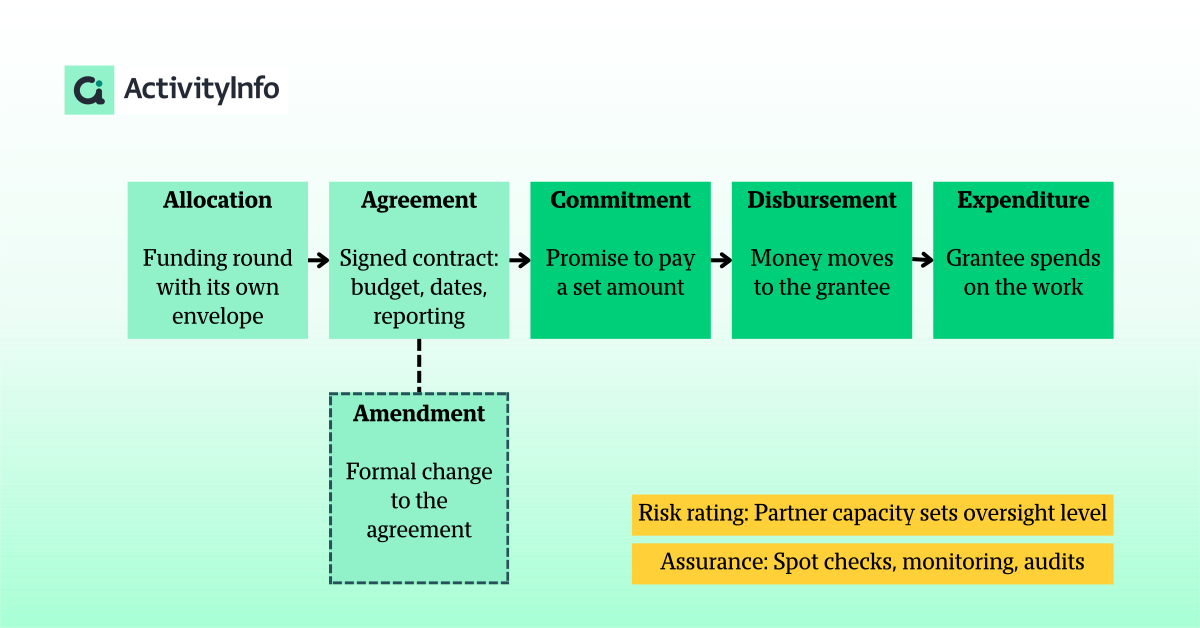
Every donor uses slightly different words, and this can create confusion. In this article, we offer a quick glossary on how we are using each term in this case, starting from the beginning of the grant lifecycle.
- Allocation: A funding round, with its own strategy, priorities and amount of money.
- Grant agreement: The partners selected in an allocation sign a grant agreement. This is a contract that sets the dates, the budget, the reporting deadlines, and the payment schedule.
- Commitments: Signing the grant agreement creates a commitment. A commitment is a firm, written promise to pay a set amount, for set purposes, on set terms.
- Disbursement: The actual transfer of money to the grantee. Commitments and disbursements are different numbers. In a given year, they rarely match, because a multi-year commitment is paid out over several years. So commitments show what the donor intends to pay and disbursements show what was actually paid.
- Expenditure: What the grantee actually spends on goods and services.
- Amendment: A formal change after signature. Not every grant has one, and it can happen at any time.
Alongside all of this runs oversight.
- Risk rating: Describes how strong a partner’s financial management is. It decides how closely the donor monitors them.
- Assurance: How monitoring confirms that the money was used as agreed happens. It can include spot checks, monitoring visits and audits.
While there is no official list of the types of grants, we can consider various elements that affect managing a grant, which also affect what an information system needs to store.
- Selection: How the donor chooses grantees. It can be an open call for proposals, where anyone eligible can apply. Or the donor can invite a few partners directly, for example in a sudden emergency, when speed matters. Humanitarian pooled funds use both.
- Earmarking: The donor decides in advance what the money can be used for. It can be tied tightly, to specific activities or flexible, for example only tied to a country, with the details decided later.
- Contracting: Defines who signs the agreement. It can be a single grantee or a consortium consisting of several organisations under one agreement, with a lead organisation that talks to the donor.
- Disbursement: Harmonized Approach to Cash Transfer (HACT) describes three ways of how the funds are moving: An advance, before the partner spends, a direct payment, from the donor to the suppliers, or a reimbursement, after the partner has spent an amount.
- Duration: Some grants run for a single cycle, often 12 to 24 months and others are multi-year.
Processes in grant management: The data lifecycle
Next, it’s helpful to consider the data lifecycle across each stage in grant management. This will inform our data model and the structure of the information management system too.
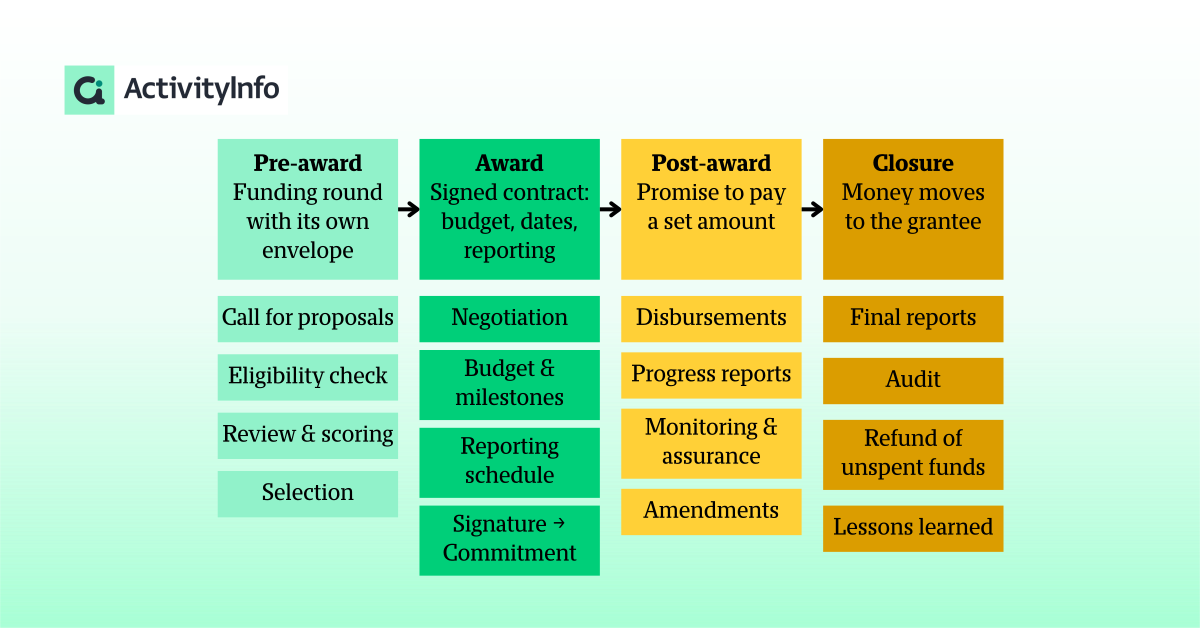
- Pre-award: The donor launches a call for proposals, and partners apply. The applications are checked for eligibility, then reviewed and scored. Then, the donor makes a selection.
- Award: The donor and the selected partner negotiate the details. They agree on the budget, the milestones and the reporting schedule. When they sign the agreement, the money becomes a commitment.
- Post-award: The donor disburses the money, and the grantee sends progress reports. The donor monitors the work and runs assurance checks. Amendments also happen in this phase.
- Closure: Final reports, an audit, the refund of any unspent money, and lessons learned for the next round.
Each stage produces information that the next stage needs. If your pre-award data is in emails and spreadsheets, and your post-award data is in a separate tool, you lose that connection. Keeping it connected with a grant management system addresses this challenge.
People in grant management: Key stakeholders
When we consider the design of an information system it is important to think about the people it will serve. In grant management, when we approach the system design from the perspective of the grantor, there are some key groups of stakeholders:
1. The donor, grantor, funder or grantmaker:
They provide the funds, set the rules, select the grantees, and check how the money is used. This is not just one stakeholder but an entity that consists of multiple teams or professionals that make grantmaking possible. When designing the system we need to consider each one of them.
- Boards of trustees set strategy and approve funding envelopes. They care about portfolio-level results, strategic alignment, and reputational risk.
- Program officers / grant managers are the day-to-day link to grantees. They design calls, assess proposals, negotiate agreements, and monitor progress, so they handle the most detailed and varied information.
- Finance and compliance teams handle disbursements, budget verification, audits, and fraud and other types of screening.
- Review panels and technical experts evaluate proposals against criteria during the selection process.
- Legal teams draft and interpret grant agreements, conditions, and amendments.
There is also the concept of a pooled fund: Several donors give money to the fund, so for them, the fund is a grantee. Then the fund gives that money to partners, so for them, it’s a donor. So the same organisation can play both roles at the same time.
2.The grantee, implementing partner or grant recipient:
The grantee is responsible for using the money as agreed, and for delivering the results. We also encounter the sub-grantee, subrecipient, or implementing partner (as defined by DG ECHO): The sub-grantee receives part of the money from the grantee. So for that part, the grantee acts as a donor.
Here too there are multiple teams working together:
- Senior leadership and boards decide which opportunities to pursue and are accountable for the organization’s commitments.
- Project managers and program staff design and implement the activities and are usually responsible for narrative reporting.
- Finance officers prepare budgets, track expenditure against budget lines, and produce financial reports.
- M&E / information management staff design indicator frameworks, collect and aggregate data, and ensure data quality for reporting.
- Implementing partners and sub-grantees often do the actual delivery in multi-tier arrangements, which creates a second layer of reporting and compliance flows.
3. External and indirect stakeholders
- Beneficiaries and affected communities are the people the grant ultimately serves. They are increasingly recognized as stakeholders with their own information needs (accountability, feedback mechanisms) rather than just data subjects.
- Governments and regulators may require registration, tax reporting, or alignment with national plans, and in some contexts coordinate the response (e.g. clusters in humanitarian settings).
- Auditors and evaluators independently verify financial integrity and assess effectiveness.
- Co-funders and peer organizations need visibility to avoid duplication and coordinate coverage.
- The public and media have an interest in transparency, often served through standards like IATI.
Because the words change from donor to donor, when you read donor documents, always check how they define each term.
People in grant management: Stakeholder data needs in each stage of the data lifecycle
When we combine the different stages (Processes) with the key stakeholders (People) we can have an overview of what our system needs to cover. The pre-award phase is mostly about assessment and fit, the award phase about commitments and terms, and the post-award phase about evidence and accountability. The post-award stage is where the heaviest data burden falls, and it’s mostly carried by grantee M&E and finance staff.
| Stakeholder | Pre-award | Award | Post-award |
|---|---|---|---|
| Donors / grantmakers/funder boards | Strategic priorities, funding gaps, portfolio fit | Approval summaries, commitment levels | Portfolio results, impact, lessons for future strategy |
| Program officers | Applicant profiles, proposal quality, past performance | Agreement terms, milestones, reporting schedules | Progress against targets, risks, closure status |
| Funder finance & compliance | Due diligence, financial capacity, risk screening | Budgets, disbursement schedules, conditions | Expenditure verification, audit findings, refunds |
| Review panels / experts | Proposals, scoring criteria, conflict-of-interest information | N/A | Evaluation findings (to refine criteria) |
| Funder legal | Eligibility rules, standard terms | Contract terms, special conditions, amendments | Compliance breaches, closeout obligations |
| Grantee leadership | Funding opportunities, strategic fit, capacity to deliver | Obligations and risks being accepted | Organizational performance, reputation, renewal prospects |
| Grantee project managers | Call requirements, needs data, design inputs | Workplan, deliverables, reporting requirements | Activity progress, outcomes, final narrative report |
| Grantee finance | Cost estimates, overhead rates, co-funding needs | Approved budget lines, payment terms | Expenditure tracking, financial reports, audit evidence |
| Grantee M&E / IM staff | Baseline data, indicator options, data availability | Logframe/results framework, data collection plan | Indicator data, data quality checks, aggregated reports |
| Implementing partners / sub-grantees | Partnership terms, expected roles | Sub-agreement, budget share, reporting templates | Reporting guidance, feedback on their performance |
| Beneficiaries / communities | Consultation on needs and priorities | Information on what will be delivered and when | Feedback channels, accountability on results |
| Governments / regulators / coordination bodies | Alignment with national plans, coverage gaps | Registration, who-does-what-where | Coverage data, statutory reports |
| Auditors & evaluators | N/A | Agreement and budget as baseline | Financial records, results data, documentation trail |
| Co-funders / peers | Who is funding what, where | Coverage and overlap | Shared results, lessons learned |
| Public / media | Open calls, funding priorities | Published awards (e.g. via IATI) | Transparency on spending and results |
Information management challenges in each grant management phase
Pre-award phase
This is where the relationship with the grantee begins. It is where you, as a grantor, first collect most of the information about each future grant: who the applicant is, what budget they propose, and what results they promise. This information can arrive as structured data, or as PDF attachments or other types of files. How you collect it makes a big difference to how much work will be needed later in order to align all information.
There are three things that often go wrong in the pre-award phase:
- Scattered intake: Proposals arrive by email, as Word or PDF files, sometimes in different versions of the template. No one has a complete list of who applied and someone has to type the budget figures again by hand.
- Inconsistent scoring: Each reviewer works in their own spreadsheet and reads the criteria in their own way. So you can’t compare scores between reviewers or committees.
- Missing selection trail: When later on in the process, someone asks why one proposal was funded and another wasn’t, the answer is difficult to find as it can be lost in colleagues’ email threads.
Award and post-award phase
This is the next part of the process, where following the selection process, you, as a grantor, award the grant to an organization and need to monitor payments and performance. Here too, the system that you put in place can create or solve many challenges including:
- Incomparable reporting: Every grantee reports in its own format, with its own indicator definitions. A program officer can read each report, but can’t add them up. So a simple question, like “how many people did we reach?” takes days to answer.
- Payments not linked to performance: Payments go out on fixed dates, no matter what the partner spent or achieved.
- Reactive monitoring: Problems only show up in the final report or the audit. By then, it’s too late to fix them.
Technology in grant management: Solving challenges with the relational database model
Most of the challenges above can be attributed to scattered or siloed data, lack of real-time monitoring processes and tools, poor collaboration and communication among departments and between grantor and grantee. An information management system, such as ActivityInfo, that aims to solve these types of challenges leverages the relational database model and offers tools for real-time monitoring, collaboration across multiple types of stakeholders, and communication.
Here is how it solves each challenge:
- Scattered intake: With one, centralized system in place, partners can only submit proposals through the grant management system, using one template. So every proposal is based on structured data from day one and this makes it much easier to manage, score, and analyze it.
- Inconsistent scoring: In the same system, each application can be evaluated based on the same scorecard, with fixed, weighted criteria. This makes the review systematic. And because topics like protection, gender and disability inclusion can be part of the scorecard, they can really affect who gets funded.
- Missing selection trail: In the same system all decisions are documented along with who added, edited, or deleted information. Review committees can record their recommendations, and have available the outcome and the reasoning for every applicant.
- Incomparable reporting: In the same system, you can use one reporting standard. All partners report against the same indicators. And they can all use the same form to request money and to report spending.
- Payments not linked to performance: Thanks to the relational database you can easily link payments to reporting. So you can agree that if money is left over, the partner either uses it for other agreed activities, or returns it. You can decide on each new payment based on the report for the previous one.
- Reactive monitoring: You can plan spot checks, monitoring visits and audits from the start for each grant. Higher-risk partners can be flagged in the system and you can arrange that they are checked more frequently. You can track the plan during the whole grant.
Technology in grant management: Data model for the pre-award and post-award phase
The data model is the tool that will guide the design of your information management system. It should take into consideration each step in each phase in the grant management process.
Pre-award phase:
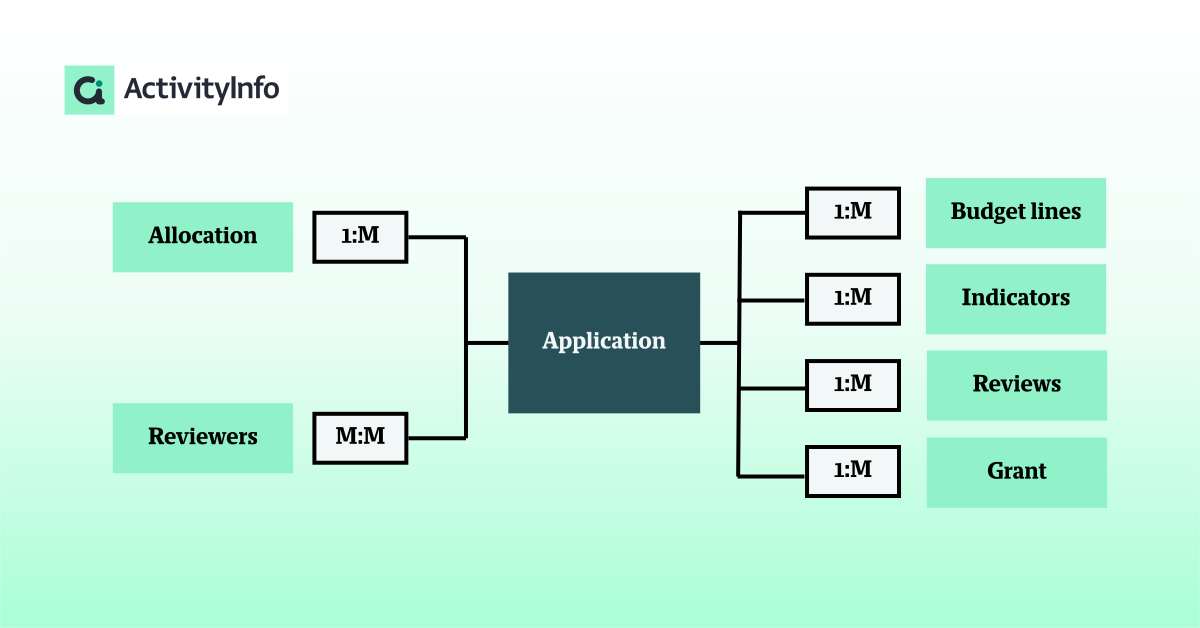
- Allocation: Before the call goes out, the donor sets the priorities, the budget and the selection criteria. The system stores them in the allocation form. This matters, because every later step depends on them: what applicants see, what reviewers score, and what gets approved.
- Application: When the call opens, partners fill in the application form. So every proposal arrives in the same structure. Nobody has to type anything again, and you always know exactly who applied.
- Review: Each reviewer fills in their own review form, with the same scorecard. The system adds up the scores. So the committee sees one clear ranking, not a pile of spreadsheets.
- Revision: Applications often go back and forth several times and can be marked as ‘Fund with revisions.’ In that case the partner can be added to the system to update the same application, and the system keeps track of each version. So you can always see what changed since the first proposal.
- Grant: You record the decision, and the selected application becomes a grant. The grant links back to the application, and the budget lines and indicators are copied over. So nobody enters them again.
Award phase:
During this phase the proposal goes through review and revision. In larger funds, there are often up to three rounds of comments and changes. At the end, both parties agree on four things and these need to be captured in the data model:
- Budget: Where the funds will be spent on, line by line, up to an agreed maximum. This maximum often depends on the partner’s risk rating and on how long the project runs.
- Scope: The activities, the locations, the people the project will reach, and the start and end dates.
- Milestones and targets: Indicators, their targets, and when each result is due.
- Reporting and payments: Reporting deadlines, payment schedule, and how the funds will be transferred. The partner might get an advance, a direct payment or a reimbursement. This also usually depends on their risk rating.
The budget and the targets are not new data elements. They come from the Application, and the partners revise them during negotiation.
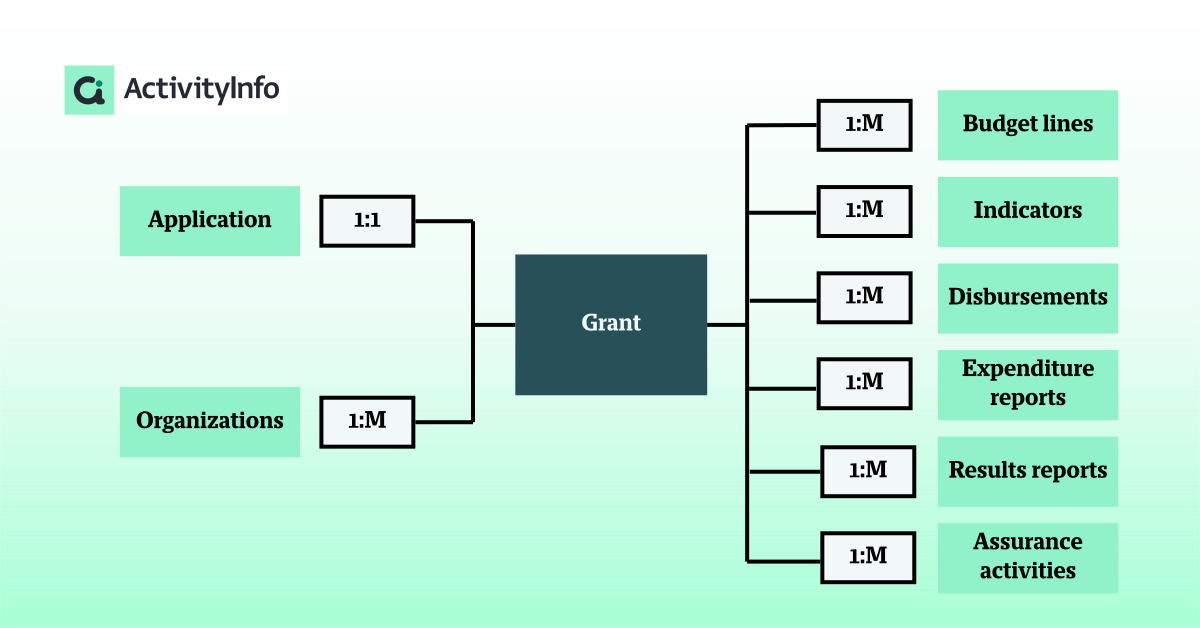
This information goes into the grant agreement. When both sides sign, the proposal becomes a commitment and the award terms become post-award data. The practical implication is simple. If the award terms only existed in a signed PDF, someone would need to retype them into a monitoring tool, and over time the two could drift apart. But if the selected application already holds the budget lines and indicators as structured data, the grant is created with everything post-award needs.
Post-award phase:
What is agreed at the award phases becomes the data you use in post-award monitoring.
- Expenditure reports for financial reporting: The budget lines become the structure (e.g. subform) for capturing financial reporting. Without them, you can’t see where spending differs from the plan, and you can’t assess a request to move money between lines.
- Results reports capturing indicators and targets: Show whether the results are on track. And if every grantee reports against the same indicator definitions (e.g. via subforms), you can compare and add up results across the whole portfolio.
- Disbursements: The information on when the money moves and under what conditions is stored in that form.
- Reporting deadlines: Become reminders, overdue flags and a compliance status for each grant.
- Monitoring capturing assurance activities: The partner’s risk rating decides how often you run spot checks, monitoring visits and audits.
Technology: ActivityInfo as your grant management software
We have been providing the ActivityInfo platform for over 15 years to the nonprofit sector worldwide. Having started as a reporting platform for the UN, ActivityInfo was then developed further to provide all the tools needed for organizations to build the information management system they need for their operations. From M&E to case management, and from program delivery to rapid response and humanitarian coordination the system allows you to create any structure you need. For grant management, ActivityInfo is ideal if you are looking for:
Flexible, no-code data modelling
- Build and change your own system without developers: Users can create and modify relational databases, forms and reports themselves, without coding, whenever needed. The system can be shaped to how your organization actually structures grants, rather than forcing a generic model.
- Fast setup and support. The SaaS version can be up and running within a week without a technical consultant, with an intuitive data entry interface for quick training and customer support from the team. This lowers the barrier to report for smaller grantees and partners.
- Relational links between grants and program data: Grants can be linked to projects, activities, outcomes, indicators, budgets or anything else needed through interactive tables. Program officers and finance staff see results and spending in the same place.
- Adapting to grant amendments: When an amendment changes reporting requirements, the data structure can be adjusted immediately, and the change is reflected right away for field staff and colleagues. Legal and program teams don’t need to wait for a new system version after renegotiating terms.
Supporting collaboration for the full grant lifecycle
- Covers both sides of the relationship: ActivityInfo can be used by both grantees and grantors, to manage the complete grant lifecycle, including applications, budgets, and execution.
- Evidence for future proposals: By using the platform as both a post-award tool and a pre-award resource, the indicators tracked during implementation become verified evidence for the next proposal. Grantee leadership and grant writers can build proposals on institutional memory rather than hunting through scattered files.
- Automations and email notifications: Automations can be triggered when a record is added, edited or deleted, or by a record’s date field, before, on or after a deadline, with filters to define when the action applies, and can send templated emails to users or roles describing the specific record, with a link back to it in ActivityInfo, or fire webhooks to external systems. Reporting deadlines, submissions, approvals and grant closures are followed up automatically, so funders and grantees can enforce timelines consistently and escalate delays without manual tracking.
Data quality and efficiency
- Validation and rules in form design: Advanced form settings and rules help prevent duplicate data and duplicated effort. Your staff spend less time cleaning data.
- Multi-level aggregation: Data from different projects, countries and regions can be combined for a global overview. Donors and boards get portfolio-level views without manual consolidation.
- Multi-partner reporting: ActivityInfo has long been used for coordination across multiple partners, clusters and sectors, such as 4W reporting. It is well suited to multi-tier arrangements with implementing partners and sub-grantees, and to coordination bodies needing who-does-what-where data.
Compliance, security and accountability
- Granular permissions and roles: Grant and program data can be protected with advanced user permissions and roles. Each partner or sub-grantee can be added to the system and be assigned a role that allows them to see only their own data, which matters for data protection and fair partnership.
- Locking reported data: Changes can be locked once grant results have been reported. What was submitted to the donor stays fixed, which auditors and finance teams rely on.
- Audit log and data recovery: An audit log records user actions and changes, and deleted data can be restored by users themselves. So there is a clear documentation trail for auditors and evaluators.
- Certified security: The ActivityInfo team is ISO 27001 certified, and the platform can be deployed in an in-country data center or on premise. This helps meet donor and government data residency or protection requirements.
Analysis, reporting and sharing
- A single repository: Documents, activity reports, evidence and indicators can be kept in one repository. As discussed, this reduces the data silos that make post-award reporting slow and costly.
- Dashboards and Notebooks: Financial or impact data can be visualized, combined with narrative, and shared with key stakeholders through Dashboards and Notebooks. As a result one source can serve boards, donors, co-funders and the public at different levels of detail.
- Integration options: Export and API integration support more advanced analysis, and there is an R package. You can connect to finance systems or BI tools so finance and program data don’t have to be re-entered
- Field and offline data collection: The platform supports mobile data collection and working offline or online. Implementing partners in low-connectivity settings can still report reliably.
Technology: Getting started with a database template
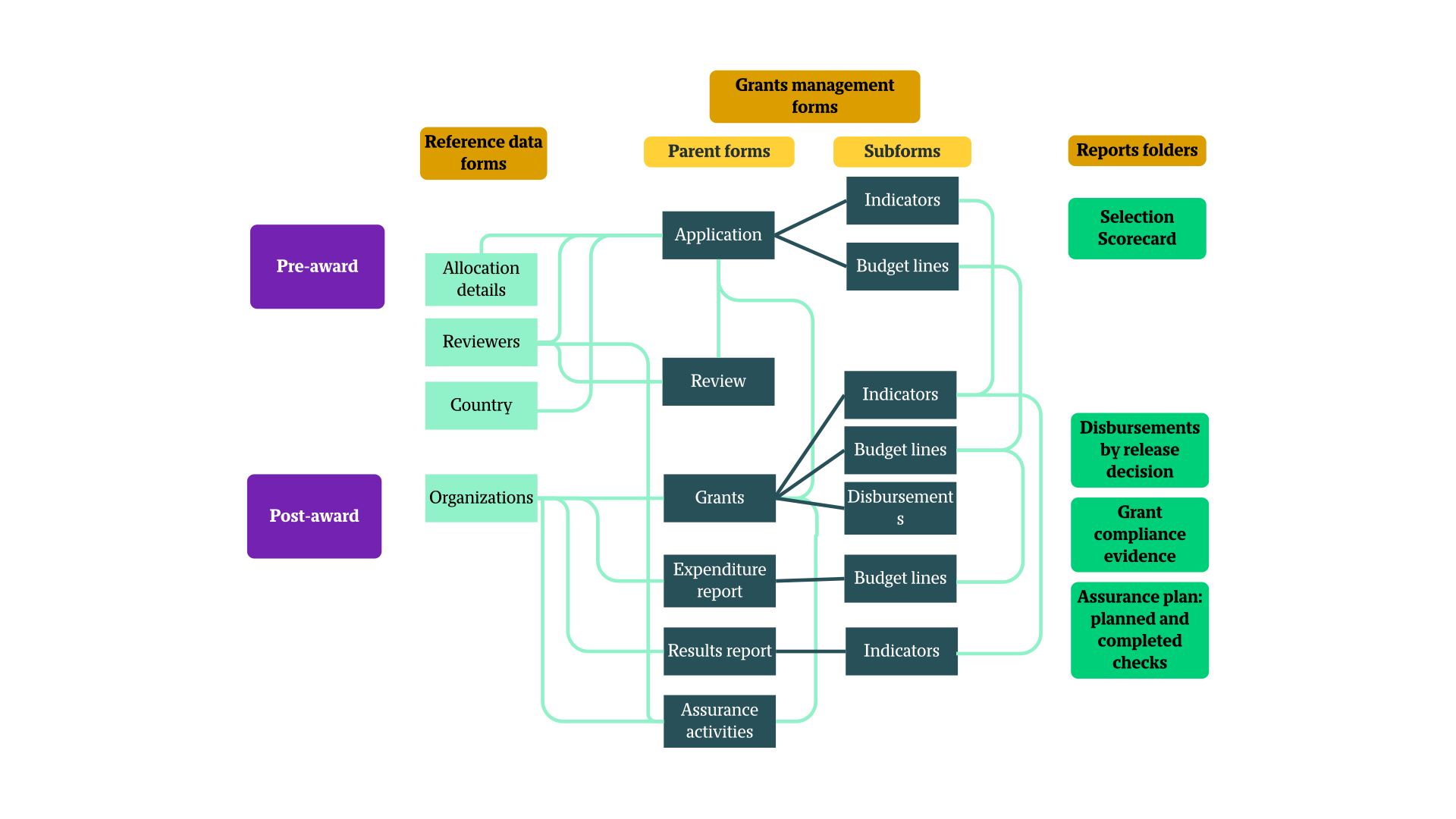
To help you get started with your own information management system for grant management, we developed a database template that you can copy and use for your own grants. The database includes folders, forms, subforms, records and user roles that can be adjusted to your needs. You can also add new elements to the database and use it for demonstration or practice.
Conclusion
All in all, with an information management system designed for grant management your organization can save time and improve processes. Selection, award and monitoring are not three separate processes but one connected flow of data and an efficient grant management system helps you keep all information connected.
Whether you will be using ActivityInfo or another system as your grant management platform, here are some best practices to keep in mind:
- Structure your data at intake: Store the proposed budget lines and indicators as structured fields in the application, not as attachments. Everything that comes later depends on this.
- Make selection traceable: Use one shared, weighted scorecard. Keep one record per review. And control access by role, so reviewers only see and score what they’re assigned. Then you can explain and defend every selection decision.
- Treat the award as the plan: The budget, the scope, the targets, and the payment and reporting schedule aren’t just contract terms. They’re the data you use in post-award: for payments, reports and monitoring.
- Link everything to the grant: Disbursements, reports and checks all link back to one grant record. Program and finance staff work on the same record. And the amount of monitoring depends on each partner’s risk level.
Do you wish to discuss your grant management system with us and how ActivityInfo can support your work? You can always schedule a Demo with our team.