Untangling Programs, Projects, and Grants - How the Relational Data Model Brings Consensus Among Teams
In grant-reliant organizations, there is often a persistent internal challenge: the inability to clearly distinguish between a program, a project, and a grant during the planning phase or even at later stages. Project teams, finance departments, and M&E specialists frequently use these terms interchangeably, for example calling an activity by its donor's name (e.g., "the Global Fund project").
This confusion usually starts when an organization is young and relies on a simple, 1:1 relationship where one grant funds one project. In this simple, one-to-one scenario, the grant timeline and the project activities match perfectly, and the habit of using the terms interchangeably becomes deeply ingrained.
However, as the organization grows, this flat mindset breaks down. A single project may require blended funding from multiple grants, or a single major grant may be distributed across several distinct projects. Trying to manage this multi-donor reality without clear distinctions leads to compliance concerns, rigid project design, and reporting issues.
At the same time, M&E officers face their own challenges. Donors want to see indicators tied to the grant, but the actual impact happens at the program or project level. If the data architecture treats them as the same thing, M&E officers spend weeks manually untangling spreadsheets to figure out which participant success story belongs to which funding source.
In this article, we discuss how untangling Programs, Projects, and Grants requires moving past simple definitions. To bridge the gap between financial compliance and programmatic impact, organizations must first clearly define the concepts and then translate them into a shared structural framework. By mapping these relationships into a formal data model and ultimately encoding them into a relational database, organizations can establish a single source of truth that naturally forces team consensus, satisfies donors, ensures funding isn’t underutilized, and keeps the focus on executing the mission.
Setting clear definitions
To resolve organizational friction, teams must move past the idea that a grant and a program or project are the same entity. The easiest way to distinguish Programs, Projects and Grants is by looking at what they are, how they are funded, and why they exist.
A program represents the why and the long-term vision of the organization. A project is what you do to achieve it. A grant is a legally binding financial instrument provided by a donor to fund specific activities under strict compliance guidelines. It is bound by its own legal timeline, reporting schedules, and a restricted line-item budget.
These three concepts are not legally or conceptually the same thing, even if they happen to cover the exact same timeline and scope.
| Concept | What is it? | Main focus |
|---|---|---|
| Program | A long-term, strategic portfolio of work aimed at achieving a broad, ongoing mission. | Impact & Strategy |
| Project | A time-bound intervention with a defined baseline, start and end dates, aimed at delivering specific outputs or achieving targeted outcomes within a distinct population or geographic area. | Execution & Outputs |
| Grant | A financial mechanism awarded by a funder to support specific work. | Funding & Compliance |
The core of the confusion lies in the relationship between these three concepts. While a project always nests neatly under a broader program, the relationship between projects and grants is fluid.
Understanding the operational reality
In a mature organization, these concepts interact in complex, non-linear ways, such as:
Blended funding (one project, multiple grants)
Large-scale projects rarely rely on a single donor. For example, building a community health center (a single project) might require procurement funding from Grant A, staff training funds from Grant B, and logistics support from Grant C.
The project manager treats this as a single operational plan with one timeline. However, the finance team must track three separate revenue streams. If the organization treats the project as identical to Grant A, the contributions of Grants B and C become tracking nightmares, leading to compliance risks or unspent funds.
Distributed execution (one grant, multiple projects)
Then, an institutional donor might award a high-value grant for a broad objective like "Youth Empowerment." To execute this effectively, the organization might split the funding across three distinct projects: a summer camp, a high school mentorship program, and an IT lab upgrade.
Here, the grant is the overarching financial umbrella, while the projects are the distinct vehicles of execution. If the team treats the grant as a single project, they will fail to manage the unique timelines and milestones required to make each individual initiative successful. Also they will need to roll up the metrics of all three projects to prove to the funder that the overarching grant objective was met.
Steps to internal consensus
A shared language and a common understanding of roles and responsibilities is a good starting point. Some first steps you can take are the following:
- Create an institutional glossary: Write down the definitions above in a central document. If it’s not written down, the definitions will drift.
- Implement a "funding vs. doing" rule: Force teams to separate the activity from the fund. When someone says, "We are starting the Global Fund grant," gently correct them: "We are starting the Agriculture Project, which is funded by the Global Fund grant."
- Map your architecture: Draw it out visually for your specific organization. Show a Program at the top, Projects sitting underneath it, and Grants feeding into those projects.
- Designate clear roles: Project Managers own the timeline and outputs. Grant Managers/Compliance Officers own the funder relationship and the rules. Program Directors own the big-picture impact.
- Define what success means for each case: Define what it takes for a successful project and what for the success of the grant. Accept that a piece of work can be a project success but a grant failure or vice versa.
The role of the data model
Establishing shared definitions is a crucial first step, but definitions alone will not survive the daily pressures of project execution and financial reporting. If an organization continues to rely on flat spreadsheets for a multidimensional reality, staff will inevitably default to old habits conflating projects with grants out of convenience and the challenges will come back.
To permanently institutionalize consensus, the organization needs to translate the conceptual definitions into a structured data model. A data model acts as the blueprint for how information flows through the organization and forces the systems used by finance, programs, and M&E to align. In addition, a relational database that supports such a model helps ensure that the relationships between these elements and their datasets are respected.
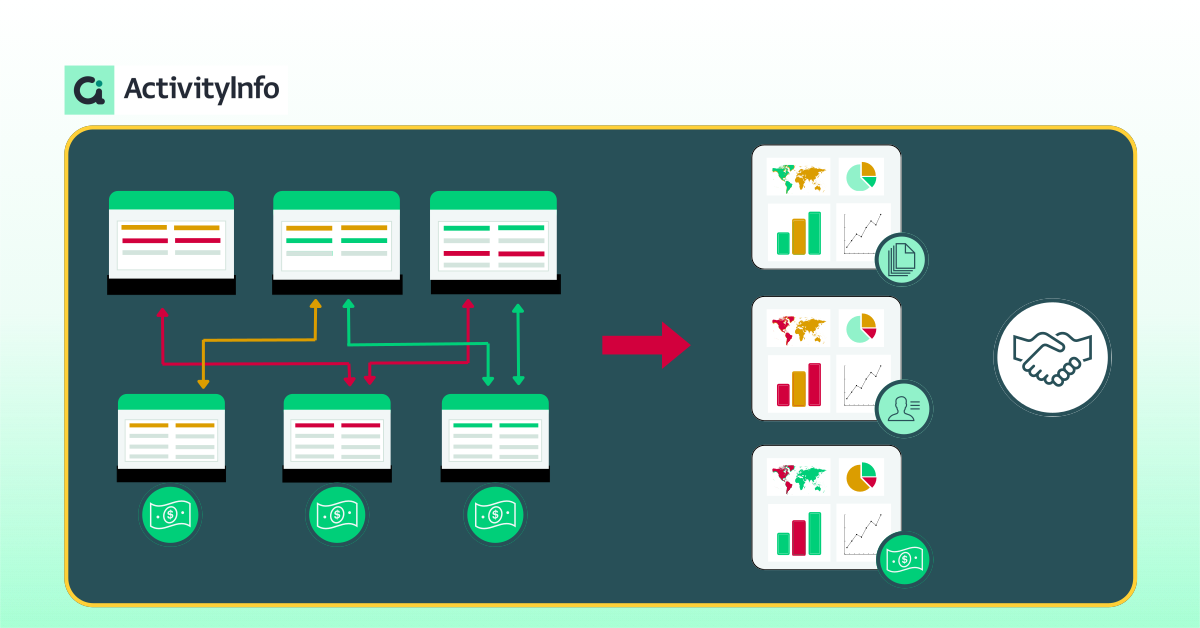
Instead of treating data as a flat list where "Grant," "Project," and "Program" are text columns in a spreadsheet, a relational model treats them as independent, interconnected entities. Embracing this structured approach offers three important advantages:
1. Enforced organizational rules: In a relational database, the software enforces your operational logic. You can hard-code rules into the system, for example, decreeing that a project must be linked to a strategic program, or that an expense cannot be logged unless it is mapped to an authorized grant allocation. The system boundaries eliminate data entry errors and prevent staff from slipping back into the habit of using terms interchangeably.
2. Multi-dimensional reporting (simultaneous views): A relational model naturally satisfies the conflicting priorities of different teams by allowing you to generate custom, real-time views from the exact same data set. For example:
- The Finance Team gets a grant-centric view, tracking total donor awards, allocations across various initiatives, and line-item burn rates.
- The Project Manager gets a project-centric view, seeing a unified operational budget that seamlessly blends funds from multiple grants behind the scenes.
- The M&E Officer gets a program-centric view, easily aggregating impact metrics at the strategic level while maintaining the ability to trace data back to specific donor funding streams.
3. Elimination of "double-dipping" risks: By utilizing a many-to-many data structure, the database acts as a clean ledger. It tracks exactly how much money from Grant A and Grant B is allocated to Project X. This absolute transparency completely removes the anxiety of accidental double-billing, giving finance and programs the confidence to utilize blended funding safely.
ActivityInfo as the solution
ActivityInfo is an information management platform that inherently supports relational database architecture:
- Native relational form design: ActivityInfo allows you to create separate forms (or tables) for your Programs, Projects, and Grants. Using Reference Fields you can link these forms together precisely as defined by your data model, effortlessly handling complex, multi-donor relationships.
- Collaboration without siloed data: Because it operates as a single, cloud-based platform, ActivityInfo bridges the gap between functional teams. M&E officers, project managers, and partner organizations all log data into the same relational ecosystem, ensuring everyone works from a single source of truth.
- Flexible, granular permissions: You can create and assign specific roles within the system. Project managers can update activity milestones, while finance or grant officers control the funding allocations, ensuring data integrity without restricting operational speed.
- Custom views and reports: You can create diverse views for different users of the system to focus on specific aspects of a program, grant or project. Or you can create dashboards and notebooks for a high level overview of every aspect of these entities.
By leveraging a system like ActivityInfo, you put in place the framework that drives consensus, secures compliance, and keeps the team focused on delivering impact.
Would you like to learn more about how ActivityInfo can support your grants management activities? Never hesitate to contact us.