Navigating Post-Award Grant Management - Tracking Project Revisions Safely with ActivityInfo
When an organization receives a grant, the implementation plan is based on a project proposal written months or sometimes even a year prior to the grant award. In the world of international development, humanitarian aid, and complex field operations, project environments are rarely static. Local economic conditions shift, supply chains face disruption, or initial baseline assumptions turn out to be incorrect once operations begin on the ground.
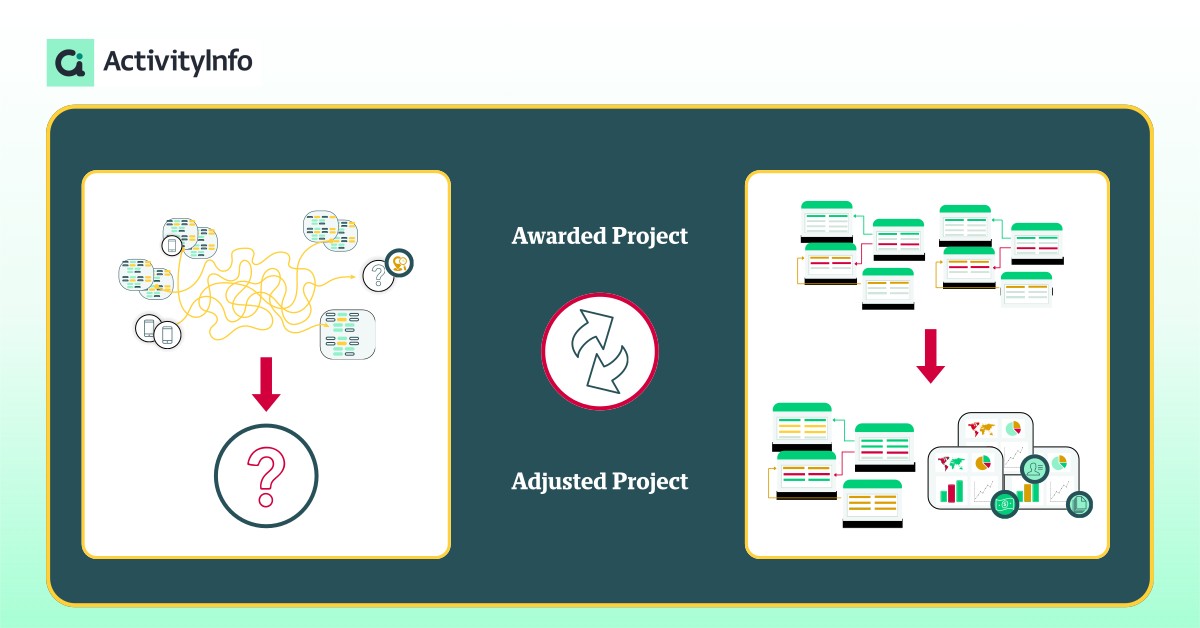
Institutional funders and donors fully recognize this reality and while they are open to adjustments, they expect accountability and responsiveness. Most donor agencies allow projects to adapt through formal administrative processes, such as post-award amendments, grant award modifications, or no-cost extensions.
While donors provide the regulatory flexibility to approve these shifts, grantees face a major operational hurdle: managing the data before and after the change happens. When a grant is amended mid-stream, targets, tracking indicators, or budget allocations change. If an organization relies on flat, static files to monitor progress, this necessary project pivot can create administrative challenges.
Why traditional grant and project tracking fails after an amendment
To track project execution against a newly revised grant agreement, organizations typically rely on manual document adjustments. These methods can break down under the weight of a formal change especially in larger projects and programs.
Duplicate files, latest versions
When indicators or targets change, system administrators usually update their master spreadsheets and save a new version of the file, using names like ‘Indicator-Tracking-v2-Amended.xlsx’.
Why it fails: In a decentralized organization, you cannot ensure that every field officer immediately deletes the old spreadsheet and switches to the new. Staff members frequently continue entering data into obsolete templates saved on their local desktops. This leads to fragmented data collection and forces headquarters teams to spend days manually combining old and new files.
Broken timeline
A project revision often splits a grant into two distinct phases: before the amendment and after the amendment.
Why it fails: In a standard spreadsheet, historical data collected during the first few months of the project becomes difficult to compare against the revised indicators introduced in the second phase. The timeline becomes disconnected, making it hard to generate a single, continuous progress report for the donor at the end of the year.
Lack of direct links between budget and project changes
During an annual review or an official audit, organizations must prove that every unit of funding spent aligns with the approved project scope.
Why it fails: When shifts are tracked across separate spreadsheets and unlinked files, the justification for a budget reallocation can be buried in detached email chains or text memos. Without a direct data link between the formal donor approval and the updated expense log, demonstrating compliance during an audit becomes a stressful, manual reconstruction of events.
The solution: Adaptive management through structured data
To manage project revisions safely you can transition from a document-centric approach to a structured data approach.
In a structured data system, information can be organized using the relational database model. Instead of saving data in independent spreadsheet rows, information can be stored in data fields that can link to each other and data quality can be preserved with predefined rules. For example, when a project receives an official amendment, the database structure itself would be modified, rather than creating an entirely new file.
This structural agility solves the operational challenges of a mid-course revision in three specific ways:
- Preserving historical data: In a relational database, entries collected under the original project scope remain locked and secure. New validation rules and modified indicators only apply to data entered after the date of the amendment, ensuring the integrity of the entire project history.
- Enforcing uniform data entry: Because field staff log into a centralized database interface rather than using local files, old records are replaced instantly. The moment the administrator updates a tracking field, the change rolls out to every user simultaneously, entirely eliminating version control issues.
- Real-time, multi-baseline reporting: A structured system allows you to map old indicators to new targets much more easily. For example, you can design a dashboard that allows leadership to view performance against both the original proposal baselines and the newly amended targets on a single screen.
Building flexibility into operations and post-award grant management with ActivityInfo
Transitioning a complex project mid-course requires a software platform designed specifically to accommodate the quick changes in the field. For organizations managing adaptive programs, ActivityInfo offers a secure, relational database solution that handles project updates safely.
ActivityInfo is a no-code platform, meaning project administrators can modify data entry forms, update tracking indicators, and add new fields mid-course without needing custom software development.
When a grant amendment changes your reporting requirements, you can adjust the underlying data structure in ActivityInfo immediately, and the update is instantly reflected for all field workers and other colleagues.
More functionalities that can facilitate grant management and project revisions:
- Form versioning: Administrators can modify data entry fields and tracking indicators mid-project without losing or altering past entries collected under the original proposal scope.
- Relational subforms and reference fields: You can easily add new activity logs to an existing grant structure, keeping the initial and the revised data separate but linked to the same donor contract.
- Automated recalculations: When targets change, updating the central field automatically recalculates all indicator progress across your dashboards, eliminating manual formula management.
- Read-only fields: You can turn old data fields into ‘Read-only’ fields to prevent staff from entering data into obsolete metrics, while creating new fields for active reporting.
- Built-in dashboards and integrations: You do not have to redesign your reporting dashboards from scratch. Because the data model is updated in real time, your ActivityInfo dashboards or dashboards created by integrating with external visualization software will automatically adapt to the new data flow.
Furthermore, ActivityInfo maintains an audit trail by automatically tracking changes in the database. This ensures that as your project adapts to realities on the ground, your data remains clean, continuous, and fully compliant with donor requirements.
Do you wish to discuss how ActivityInfo can support you post-award grant management operations? Never hesitate to contact us.