Using Evidence to Win More Grants - How a Centralized Information System Builds Institutional Memory for Your Nonprofit
For a grant writer, the most stressful hours aren’t spent writing; they are spent searching. As a deadline approaches, a donor might ask for a specific evidence base: "Provide a three-year track record of your impact on water-table levels in the Sahel region." In many organizations, this triggers a long process of evidence gathering. Staff dig through archived PDFs, search for the final reports of former colleagues, and cross-reference old Excel files that may or may not be the "final" version.
By the time the data is found and verified, the grant writer has lost the time they needed to craft a truly compelling narrative. This is where an information system such as ActivityInfo becomes a vital resource for strategic grant management.
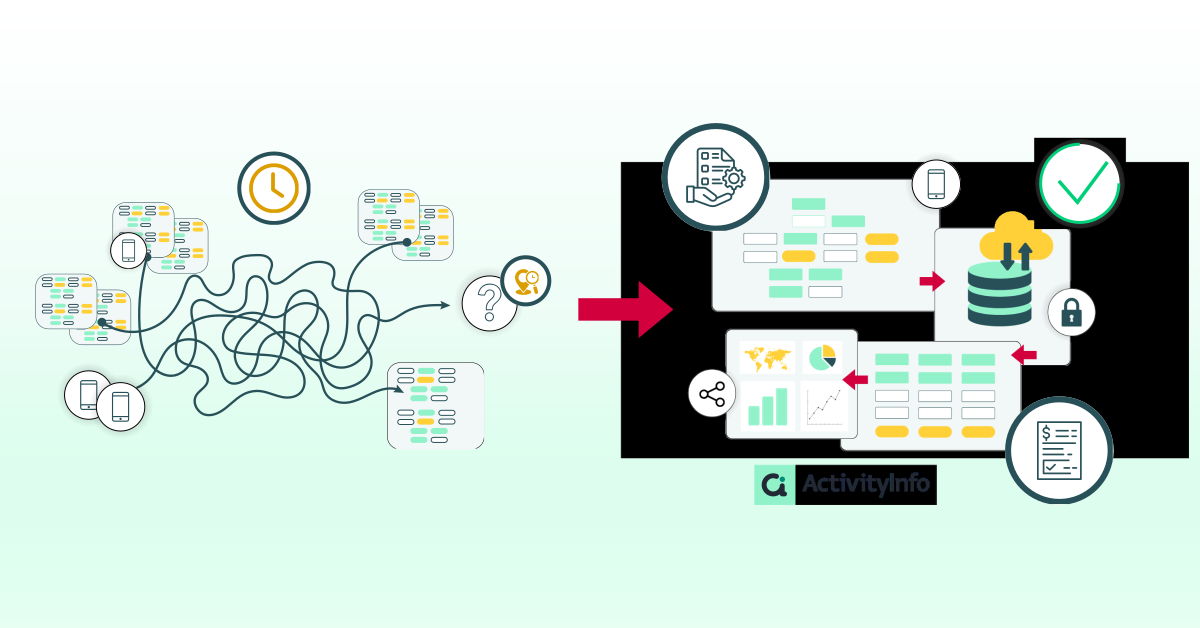
An integrated system that combines grants management, MEAL data tracking, and impact measurement acts as a searchable "evidence repository" for nonprofit organizations. By centralizing impact measurement and MEAL data, grant writers can instantly filter historical results by region, sector or theme. This eliminates the "data scavenger hunt" during proposal development, allowing teams to prove their track record with verified, real-time evidence, increasing the likelihood of securing new funding.
In this article, we discuss why static information is an inadequate source for grant writing, and how you can shift to an ‘evidence repository’ that sustains institutional memory which can be leveraged to win proposals. We also discuss how ActivityInfo can support not only your MEAL activities and post-award grant management requirements but also your pre-award grant management needs.
The problem with "static" information and grants
Most nonprofit data is "frozen" inside static reports. Once a project ends, its results are often locked in a narrative document. This creates several challenges for the organization:
- Loss of institutional memory: If the project manager who oversaw a successful intervention leaves, their nuanced understanding of the results often leaves with them. Without a database, your nonprofit might lose important information.
- Inability to aggregate: If you have worked on food security across five different grants, it is nearly impossible to quickly sum up your total reach if those results live in five different folders.
- Credibility Gap: Donors are increasingly sophisticated. They know the difference between a "placeholder" statistic and a precise, data-backed capability statement.
Moving to an evidence repository model for your grants
When you manage your grants and MEAL frameworks within a relational database like those you can build in ActivityInfo, you aren't just filing reports; you are building a repository of evidence.
Instead of searching through documents, a grant writer can use the system to filter by region, year, or indicator. Within seconds, they can see the aggregated impact of every intervention the organization has ever conducted in a specific sector. This shifts the role of the information system from a "Post-Award" requirement to a "Pre-Award" advantage that makes it easier to:
- Prove track record with verified data: A relational system allows you to pull historical data that is already verified. When you can state with confidence that your organization has maintained a 95% success rate across twelve past grants in a specific technical area, your proposal moves from "hopeful" to "proven."
- Demonstrate data maturity and transparency: With grants, donors are investing in an organization. By including maps, charts, and real-time data visualizations directly from your information system into your grant proposal, you prove that your organization is "data-mature." It signals to the donor that their funds will be tracked with professional rigour.
- Harmonize global indicators: For larger nonprofits, the ability to show global impact is essential. If your country offices use standardized indicators within a central system, the headquarters team can pull a high level overview at the global level much more easily. This allows the organization to compete for large-scale, multi-country funding that would be very challenging administratively to coordinate via spreadsheets.
A MEAL system that actively contributes to grants writing and fundraising
To turn your M&E system into a tool that contributes to grant writing and fundraising, the transition requires a few practical shifts in how data is handled:
- Standardize indicators early: Use the same "core" indicators across different grants so that data can be aggregated over time for long-term impact measurement or to showcase ‘global impact’.
- Tag by theme: In your database, tag projects not just by their donor, but by their "Thematic Area" (e.g., Climate Resilience, Gender Equity) or other key category that can support your grant writers. This makes them instantly searchable for writers focused on those topics.
- Create and share reports that showcase impact: Leverage the wealth of data and help grant writers by providing them with high level reports that include the numbers they need to talk about your organization’s expertise and past impact.
- Maintain archives: Ensure that when a grant ends, the data remains accessible in the system rather than being archived in a way that makes it unsearchable.
The true value of an information system such as ActivityInfo is realized when it is given the opportunity to contribute to more parts of your nonprofit, in addition to the M&E department. When a grant writer can log in and find exactly what they need to prove the organization’s worth, ActivityInfo becomes more than a system of record, it takes the role of an ally to grant writing and fundraising.
The no code relational database model makes it easy to link activities to global indicators, geographic locations and past or current grants. This way your teams can have a living ‘archive’ of information where institutional memory is preserved even after a project team has moved on. Then, with filters, views or built-in analysis tools and visualizations you can provide the exact information that is needed to your grant writing team.
Then, by using ActivityInfo as both a post-award management tool and a pre-award resource, the data loop is closed. The indicators you track during the implementation phase become the verified evidence for your next proposal. This harmonization ensures that the promises made in a grant application are grounded in the actual, measurable capacity of the organization.
Curious to see how ActivityInfo could support the information management requirements in your nonprofit from pre-award grant writing to program management to post-award monitoring? Never hesitate to contact us.