Post-award Grant Management and the Data Silo Tax - How Disconnected Systems Drain Your Program Budget
It is 6:00 PM on a Friday. A program manager sits with fourteen browser tabs open, a stack of paper surveys, and a complex grant tracker on a spreadsheet. A donor has asked a simple, reasonable question: "How much did we actually spend for every beneficiary we reached this month?"
The answer exists, but it is trapped. The financial reports are in the ERP, the reach data is in an export from a data collection tool, and the grant agreement and milestones are in a folder on an organization’s laptop. To navigate the post-award grant management phase and ensure donor compliance, the manager must spend the next three hours manually stitching these silos together.
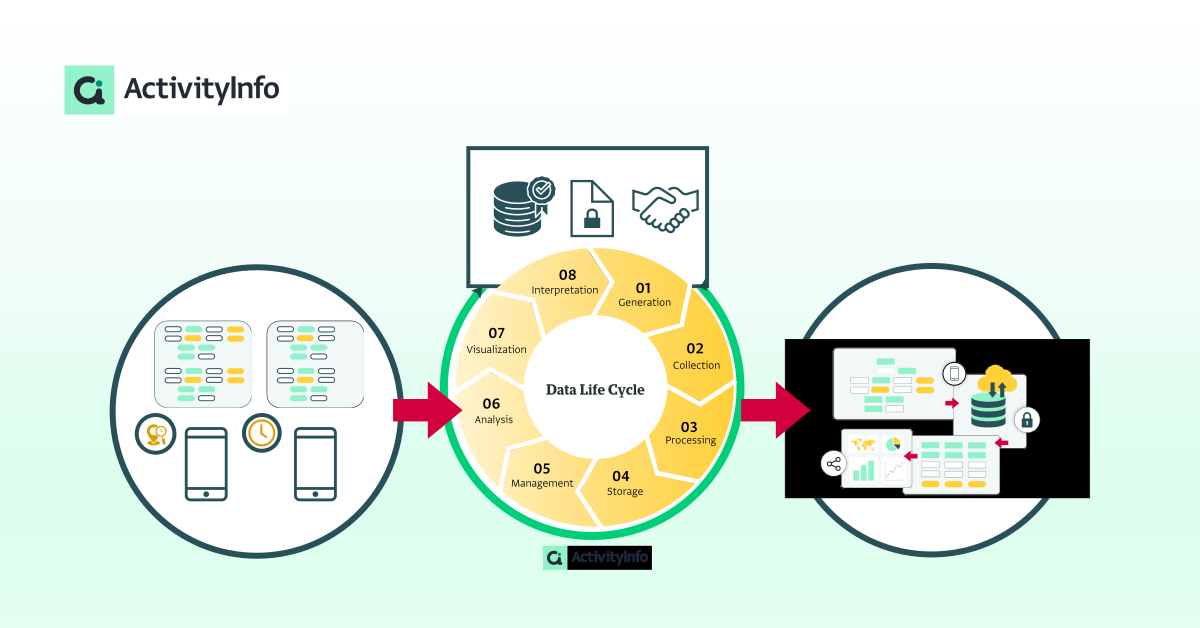
This is the “data silo tax” that most NGOs are paying at every stage of the grant lifecycle without realizing it. In this article, we look at the time and opportunities lost when a team is spending more time assembling reports than analyzing impact and discuss how you can reclaim the lost time by bridging the gap between your data silos.
The fragmentation reality
In a common reality where NGOs have adopted the "best-of-breed" software approach, finance uses professional fund monitoring tools, M&E teams use specialized collection apps, grant
managers use localized spreadsheets. While each tool is good at its specific job, they don't speak the same language. The moment you need a consolidated view of actual spend versus activity progress, the situation becomes very challenging.
Quantifying the Loss:
When we calculate the "silo tax," we look at the time spent on data admin work such as cleaning, reformatting, and merging datasets. Research suggests this consumes roughly 15–20% of staff hours.
So if for example a Senior Program Officer earns $50,000/year and spends just one day a week manually moving data between systems, that represents a $7000-$10,000 annual “data silo tax” per employee.
Beyond the salary cost, the hidden penalties are even steeper:
- The decision gap: Leadership makes choices based on "historical" data (last month’s reconciliation) rather than "live" reality.
- Version control risk: Reporting 500 beneficiaries to a donor when the M&E database was just updated to 450 creates a validation trap that erodes donor trust.
- Burnout: High-level program staff are often driven to resignation not by the difficulty of the field work, but by the weight of the reporting paperwork.
Why standard tools fall short
Many NGOs rely on a patchwork of Excel or other spreadsheets each customized to different department’s needs, data collection apps, and other data reports held together by copy-paste. This holds inherent risks and weaknesses:
- Fragility: Excel formulas break, and manual imports are prone to human error. A single deleted row can invalidate a quarterly report.
- Lack of relational logic: Most trackers show what happened or how much was spent, but they cannot link the two. Without a relational structure, calculating efficiency remains a manual chore.
- The security gap: Spreadsheets lack the granular permissions and audit trails required for rigorous international audits and regulatory compliance.
The solution: a "single source of truth"
The alternative to the “silo tax” is an integrated architecture, such as the one offered by ActivityInfo, where M&E and Grants Management live in the same environment.
In this case, when a field officer logs a participant in a list, the system doesn't just store a number. It updates a geographic map, adjusts a grant drawdown schedule, and refreshes a donor dashboard simultaneously.
There are many benefits in such an approach:
- Real-time course correction: You can spot "under-burn" or "over-reach" in month two of a grant, allowing you to pivot activities while you still have the budget.
- Standardization across partners: Lead NGOs can harmonize reporting from sub-grantees into one system, eliminating the need to chase dozens of different Excel formats.
- Audit-ready compliance: Every data point has a digital trail from the field entry to the final report.
What to do next: Determine your status
Firstly, you can audit and calculate your own "silo tax" and understand the current cost of your disconnected data. Take this short quiz to determine your status:
Answer the following questions to uncover insights on the reconciliation, data entry, and activities tracking processes:
- When a donor asks for the current "Cost per Beneficiary" or "Spend vs. Progress" on a specific grant, how long does it take your team to provide a verified answer?
- Real-time: We have a dashboard that links spend to M&E data. (Tax: 0%)
- 24–48 Hours: Someone needs to export a few sheets and merge them. (Tax: 5%)
- 1 Week+: This requires a cross-departmental meeting and manual data cleaning. (Tax: 15%+)
- How many times is a single data point (e.g., "Number of kits distributed") handled or re-entered before it reaches the final donor report?
- Once: It is entered at the source and flows through the system. (Tax: 0%)
- Twice: Entered in the field, then uploaded/copied to a master tracker. (Tax: 10%)
- 3+ Times: Field notes → Data collection app/Excel → Regional Tracker → Grant Report. (Tax: 25%)
- Check In your last audit or quarterly review, did you find activities that were fully funded but lacked M&E evidence, or activities completed that Finance hadn't billed for yet?
- Never: Our activity logs and financial records are digitally linked. (Tax: 0%)
- Rarely: We find small discrepancies during month-end closes. (Tax: 5%)
- C. Frequently: We often scramble to find "proof of work" for expenses already incurred. (Tax: 20%)
The results:
- Low Tax (Score mainly A's): Your systems are integrated. You are likely using a relational database like ActivityInfo.
- Moderate Tax (Score mainly B's): You have a "patchwork system." You are compliant, but your staff is likely experiencing burnout from repetitive administrative tasks.
- High Tax (Score mainly C's): You are paying a heavy "silo tax." A significant portion of your grant's indirect costs is being swallowed by the sheer effort of moving data between people and folders.
What to do next: Moving to an integrated system
If your results were primarily B or C, your team is likely spending more time assembling data than using it. You can start by focusing on three areas:
- Map the data flow: Identify every "tax collection" point—any moment a human is required to copy-paste data from one system to another. These are your highest risks for error and burnout.
- Define shared keys: Ensure Finance and M&E use identical "Project Codes" and "Activity IDs." If Finance calls it "Project A" and M&E calls it "Health Initiative 2024," integration will be more difficult
- Transition to a relational database: Move away from flat files (Excel) toward platforms like ActivityInfo that allow for many-to-many relationships between your grants and your field activities.
Would you like to discuss your transition from a patchwork of systems to an integrated system that will include grant management and M&E insights in one centralized place? Never hesitate to contact us to discuss your needs further.