Result Chains and the Open Standards for Conservation M&E
In a previous article, we discussed the concept of M&E in conservation and how and why the approach differs from the international and humanitarian sector. In this article, we will discuss the tools and frameworks that help us monitor and evaluate the progress of conservation programs. We will explain why the logical framework falls short and how we can complement the picture using the results chain. We will also discuss the Open Standards for the Practice of Conservation, or Conservation Standards, a core, adaptive management framework used by conservation organizations, NGOs and governments for years.
Why the logical framework falls short in conservation M&E
We have already discussed how different targets, timelines, and change factors are in conservation programs.
The logical framework, a tool familiar to most donors and widely used in the international development sector, works well when we have short and clear causal chains and outcomes that are monitored and landed within the project cycle. On the other hand, ecological change takes decades, works with non-linear tipping points, and often deals with threats that would stay invisible in a logical framework.
The Open Standards for the Practice of Conservation
The conservation community has built its own framework to bring consistency to conservation work, making learning a core element in the process. The Open Standards for the Practice of Conservation or Conservation Standards (currently on version 5.0) is a free and open framework used to help conservation stakeholders collaborative design, implement and measure the impact of biodiversity projects and programs. They have been developed by the Conservation Measures Partnership (CMP) and are regularly updated in collaboration with the broader community.
Following a cyclical framework of 5 steps, the Conservation Standards guide planning and action. These steps help teams stay organized, measure progress, and refine their work to achieve lasting impact.
Read more in the official document (v.5).
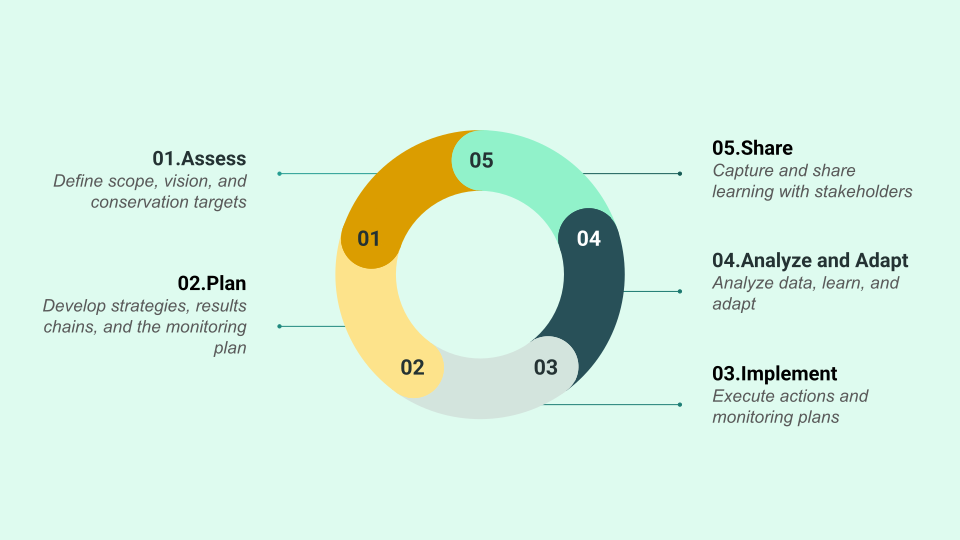
The project cycle steps in detail
Let’s have a look at each of these steps with an example based on a community forest which a village manages and protects:
- Assess: Map forest targets, timber threats, & agricultural clearings
- Plan: Set target of <0.5% annual forest loss; draft results chain, monitoring and operational plan.
- Implement: Train community forest wardens to log what they see. Define the timeline, budget and the process.
- Analyze & adapt: When you analyze data you find out that fuelwood is the true degradation driver. You decide to shift to efficient stoves.
- Share: Document and publish forest density trends globally so the next program inherits the lesson.
Another example, would be that of a coastal fishery where local fishers co-manage their own reef:
- Assess: Map coral habitat and key commercial species.
- Plan: Select target biomass; design co-management zones.
- Implement: Roll out patrol logs and visual biomass censuses.
- Analyze & adapt: Analyze data and find out that women fishers are excluded from co-management. Rebuild governance.
- Share: Show recovery results to landing sites.
Results chains versus logframes in conservation
A results chain is a diagrammatic expression of a theory of change.
It helps demonstrate how a specific action a program takes will lead to a desired result. It reflects the assumptions related to the way the strategy will help reduce threats so as to lead to the conservation of the priority targets. It consists of three elements: a strategy, expected outcomes, and desired impact. From there, you can then define objectives and goals that describe desired future outcomes and impacts, respectively.
As discussed, this is a quite different approach to the logical framework which is viewed as a ladder offering a vertical account of what we plan to deliver. Results chains offer more detail and uncover the direct relationship between each component. This makes threats more visible.
The result chain is non-linear by design with room for feedback loops and several strategies. Because you can add a monitoring indicator at each node, you can check if the strategy is working at every stage.
The quickest way to understand the differences between the two is through the image below that uses the coastal fishery example discussed above:
| Logframe | |
|---|---|
| Goal (Impact) | Reef ecosystem health restored |
| Outcome (Purpose) | Local commercial overfishing reduced |
| Output | Community co-management and alternative livelihoods established |
| Activities | Community engagement; alternative-livelihood training; patrol support |
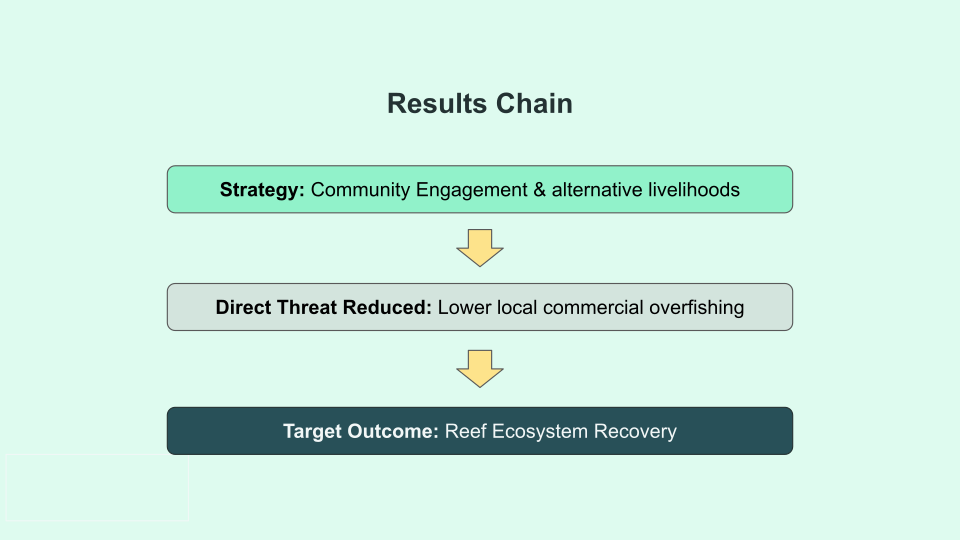
Differences between logical framework and results chain in an example:
| Results chain | Logframe | |
|---|---|---|
| Structure | Branches and loops | Linear ladder |
| Threats | Made explicit | Usually absent |
| Assumptions | Every arrow is testable | Often left implicit |
| Timeframe | Long and ecological | The project cycle |
| Strength | Learning and strategy | Accountability |
| Best used to | Design and adapt | Report to donors |
Watch our webinar Monitoring and Evaluation for Conservation - Orientation for Practitioners and Program Managers for a step-by-step example of the results chain with the example of the community forest.
Explore how Conservation International, and WeForest have been using ActivityInfo for their programs or dive-in a Case Study on the Amazonia Verde Initiative.
You can always contact us to discuss how ActivityInfo can support your needs.