Introduction to Monitoring and Evaluation for Conservation
Conservation is the protection, careful management and restoration of the natural world including species, ecosystems and the process that hold them together.
In this article, we discuss the basic principles related to conservation including its scope and stakeholders and we dive into the reasons why Monitoring and Evaluation in conservation is different from Monitoring and Evaluation in development and humanitarian aid.
Watch our webinar Monitoring and Evaluation for Conservation: Orientation for Practitioners and Program Managers for a more comprehensive deep-dive.
The scope of conservation
SImilar to how humanitarian and development work splits into sectors, conservation covers four areas with different ways of measuring results and success:
- Species & biodiversity: Programs targeting specific species or direct threats to them (e.g coral reefs, sea turtle populations, etc.)
- Natural resource management: Sustainable land, forestry, and fisheries management for communities.
- Protected area management: High-security parks, community conservancies, and transboundary corridors.
- Nature-based solutions (NbS): Actions addressing climate, water, and food security through ecosystem restoration. Lately, they increasingly include carbon programs.
Stakeholders in conservation
There is a variety of involved actors in conservation programs, each with their own objectives, timelines, and data needs, a fact that, along with other factors we explore further on, makes M&E in conservation more challenging:
- Implementers: International NGOs, national governments and parks authorities, local
- communities working on the ground. These are often the primary stewards running the programs themselves.
- Funders: Bilateral donors, the global environment facility and large foundations.
- Enablers: Research institutions and, increasingly, the private sector through carbon markets and sustainable supply chains.
The Open Standards for Conservation (v.5) list the following audiences and respective data needs:
| Audience | Typical Information needs/interests |
|---|---|
| Project teams and partners | Is your team implementing the activities as expected? Is your team achieving its objectives in the expected timeframes, and are assumptions valid? What is working, what is not, and why? How can your team improve your strategies? |
| Donors | Is your team implementing the activities as expected? Is the project achieving objectives in the expected time frames? Are the assumptions behind this project valid? |
| Interested parties | Is your team implementing the activities as expected? How will the project affect them? |
| Conservation community | What worked, what did not, and why? What may be generalizable from the project to other contexts? |
| Academics and students | What worked, what did not, and why? |
| Auditors and certifying entities | Is the project complying with laws and regulations? Is it following best practices? |
Let's see in more detail how M&E is different in conservation.
Targets in traditional M&E vs focal values in conservation
In Monitoring and Evaluation, a target usually refers to the target value of an indicator (e.g. reach 500 households).
In conservation, the term ‘target’, recently changed to the term ‘focal value’ refers to the specific biological entity, species guild, ecological community, or habitat type of interest that you are trying to conserve with your initiative. It is the reason the program exists, it guides decision-making and priority setting. Focal values in conservation are defined by ecological boundaries that existed prior to your program or project or grant cycle; they are not defined by your project. When compared to traditional M&E, we see that this is a different starting point, as in M&E the logical framework (logframe) defines its targets and objectives by what the project sets to achieve.
Another difference is that in conservation we usually encounter dual targets. Almost all conservation programs chase two targets at the same time which cannot be replaced by each other: nature and people. These two sides are intertwined. You cannot protect a forest without understanding the communities around it. As a result, the M&E system needs to track the effects both on nature and on the communities.
Timelines in conservation programs
Timelines are much more different in conservation and for this reason the frameworks used in humanitarian aid and international development fall short. Consider the following characteristics of conservation timelines:
Long time horizons: Conservation runs on ecological time. This means that we might need to wait for many years for the needle to move closer to the target when donor funded projects usually last from 1 to 5 years. This mismatch becomes clearer if we look at an example: In a forest restoration project, the project starts on Y1 and ends on Y5. However, the forest structure starts to recover on Y10 and the ecological outcomes become visible only on Y20.
Non-linear ecological changes: Ecological change is non-linear; it moves in four distinct ways and each one changes the way we should approach our data. This is also the reason why the logical framework would fail as a tool for monitoring the progress. The logframe assumes a linear, straight line from activities to results through outputs and outcomes.
Ecological change factors in detail
Tipping points
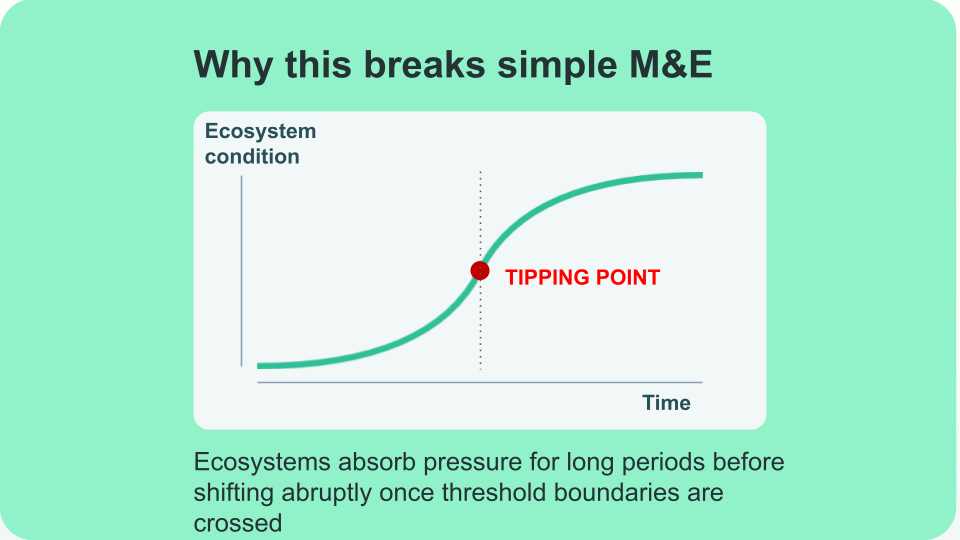
An ecosystem can gather pressure for a long time, look stable and then cross a hidden threshold and flip into a different state. For example, a fishery collapses overnight once the breeding adults drop too low or a clear coastal bay whose water turns murky and the sea grass dies once nutrients build past a point.
This is dangerous for M&E because right up until the threshold, the indicators look reassuring making us think that everything is going well. But when the system flips, climbing back up is harder than before.
Lag effects
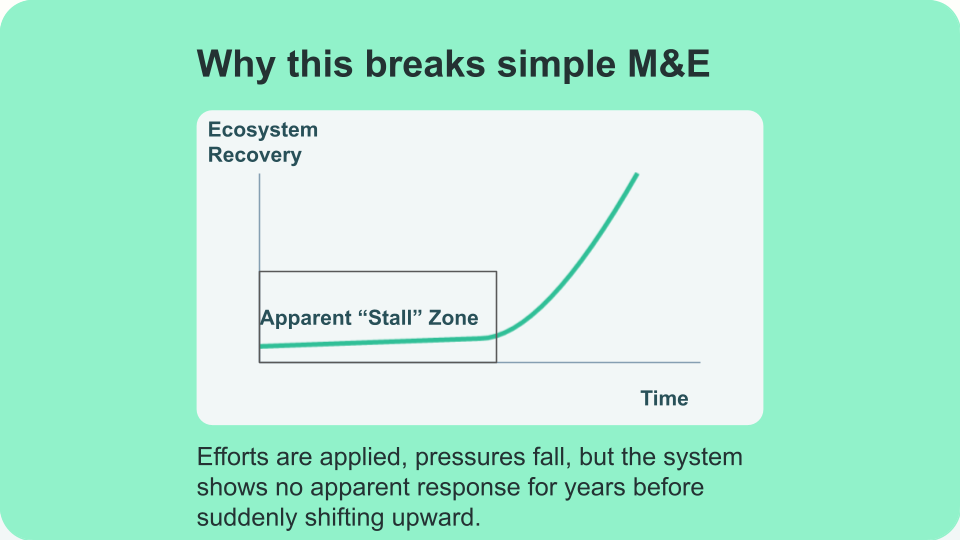
In this case the system shows no apparent response for years and this is interpreted as project failure. As a result, support gets pulled away just before recovery could show. For example, in a predator population recovery we see stagnant numbers and then a dynamic expansion once density clusters are met. Monitoring and Evaluation has an important role here, to ensure that a program is not judged too early.
External shocks
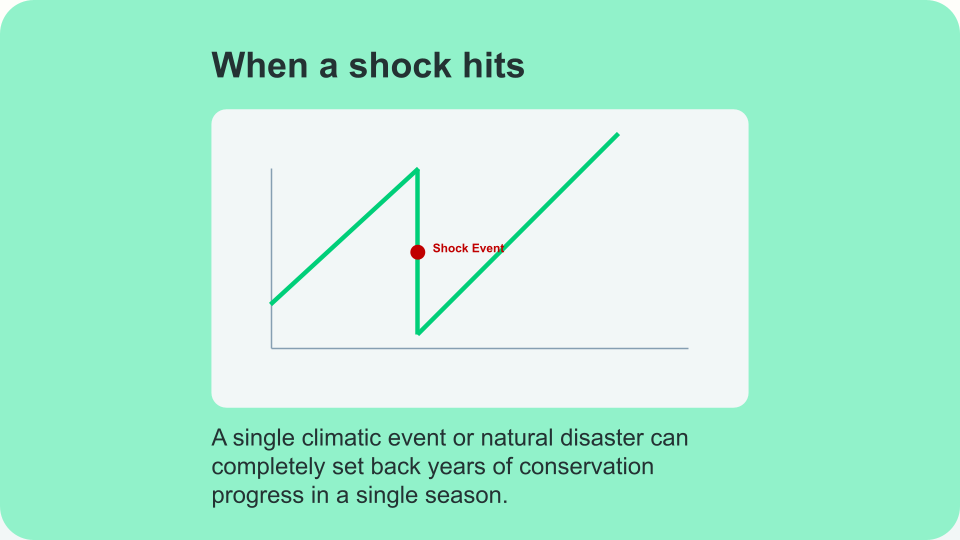
A disaster can wipe out years of progress in conservation. A single climatic event or natural disaster can set back years of progress in one season. For example, a fire season can greatly affect a woodlands area where a project for regenerating woodlands is being run for years.
If the M&E system doesn’t record the shock, then project performance can be blamed. So the M&E data should always explicitly document context changes so as to prevent false attribution of environmental failure to project performance.
Uneven recovery
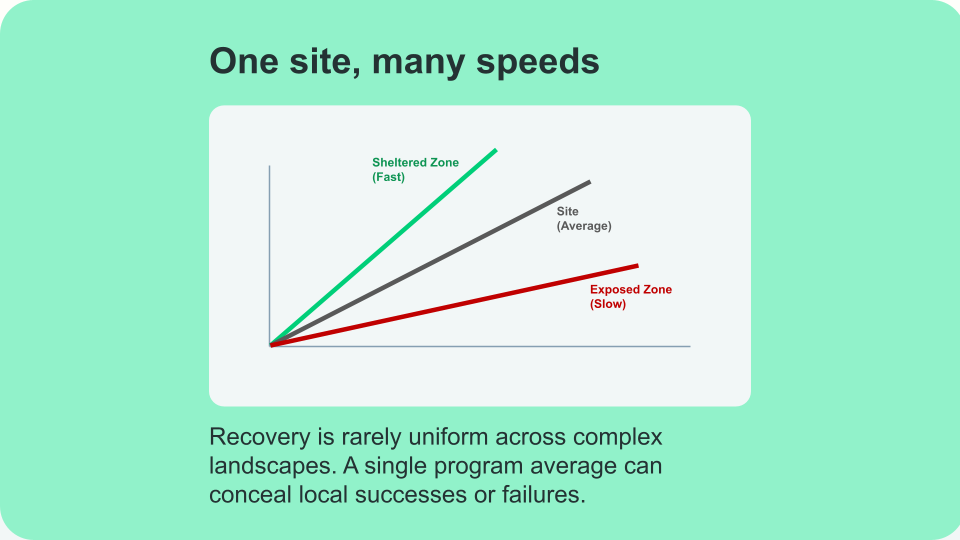
Recovery is rarely uniform across complex landscapes. As a result, if you run a single program in one zone, you might conceal local successes or failures.
The solution would be to opt for spatial variance; create M&E systems that track each zone instead of the site average. For example, in a coral reef zone, sheltered lagoon corals might recover fast whereas exposed outer-reef sections might stay degraded. If you get the average of the two zones, you would be getting a biased story.
Would you like to learn more about conservation and Monitoring and Evaluation?
Then, our webinar Monitoring and Evaluation for Conservation: Orientation for Practitioners and Program Managers.
Are you looking for an information system to host your conservation activities? Explore how Conservation International, and WeForest have been using ActivityInfo for their programs or dive-in a Case Study on the Amazonia Verde Initiative. You can always contact us to discuss how ActivityInfo can support your needs.