Primary and Secondary Data Collection for M&E in International Development
Data collection is one of the first strategic decisions in any M&E system, and it starts with a core question: What data do we need, and where will it come from? Primary data is collected directly for the specific needs of your program, while secondary data already exists, having been collected previously by governments, research institutions, or other organizations. Choosing the right source, or combination of sources, matters because the data needs to be relevant, reliable, and comparable across the program cycle.
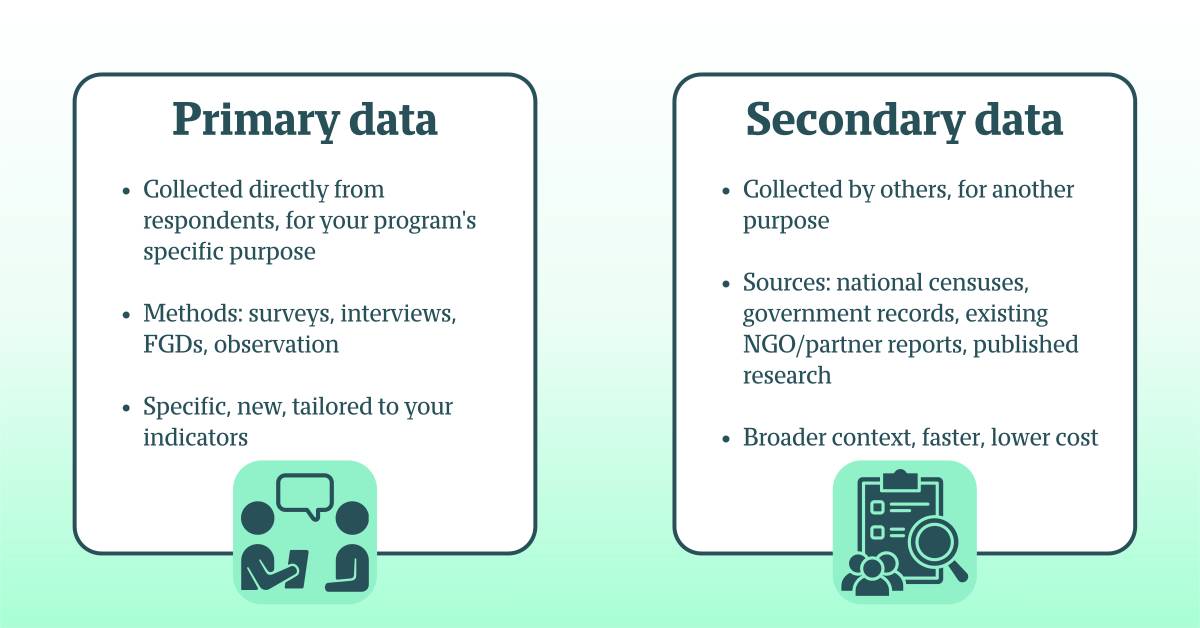
In this article, we cover the differences between primary and secondary data, how to evaluate secondary sources, and the primary data collection methods most commonly used in M&E in international development.
What is primary and secondary data?
Primary data: Collected directly from beneficiaries, communities, or key informants, using tools built for the program's specific indicators. The organization commissions it, controls it, and carries responsibility for its quality from design through analysis. Common examples are household surveys, direct observation, and interviews or focus group discussions built around the program's own indicators.
Secondary data: Data that already exists before the program starts, originally collected for a different purpose than the program's own indicators. This includes sources like Demographic and Health Surveys (DHS), Multiple Indicator Cluster Surveys (MICS), government ministry statistics, national census data, prior program evaluations, peer reviewed research, and data from partners and donors.
| Primary data | Secondary data | |
|---|---|---|
| Definition | Collected specifically for your program and its indicators | Already exists and was originally collected for a different purpose |
| Sources | Beneficiaries, communities, and key informants | Governments, research institutions, previous programs, partners, and donors |
| Organization’s role | Manages the data collection and is responsible for its quality | Uses data collected by other sources |
| Examples | Data collected directly from beneficiaries, communities, or key informants | DHS, MICS, national census data, government statistics, prior program evaluations, and peer-reviewed research |
The pros and cons of primary data collection
Because the organization designs and carries out the primary data collection itself, the team has direct control over how the data is collected. This direct ownership of the data collection process brings both advantages and disadvantages:
Pros:
- Full control over indicator relevance: The organization designs the data collection process itself, so the data can be built to match program indicators exactly, rather than adjusted to fit once data collection is complete.
- Data Traceability: Every data point can be traced back to how, when, and by whom it was collected, which is essential for donor accountability and audit requirements.
- Precise disaggregation: Data can be broken down exactly as needed, whether by sex, age, location, or another category specific to the program.
- Ownership of bias: The team working on the data collection system controls the collection process end to end, allowing bias to be identified and mitigated through design choices like question wording, rather than inherited from a methodology it doesn't control.
Cons:
- Higher cost: Expenses such as enumerator wages, transport, and field logistics add up quickly across multiple sites or collection rounds.
- Longer timelines: Designing the tool, piloting it, training enumerators, and collecting the data all take time, and that timeline may not fit a program's reporting schedule.
- Enumerator training burden: Data quality depends on consistent training and supervision, which needs to be maintained as staff change over time.
The pros and cons of secondary data collection
On the other side, when organizations choose to rely on secondary sources, they use data they did not design or control themselves, a decision that also comes with both advantages and disadvantages:
Pros:
- Faster to access: The data has already been collected by an external source, so teams can move directly to analysis without first designing, piloting, and running a collection tool of their own.
- Lower cost: Secondary data avoids the direct expenses of primary collection, such as enumerator wages, training, and field logistics, because an external source has already covered them.
- Useful for contextual baselines: Sources such as census data or national surveys can establish a starting picture before primary data collection begins.
- Sometimes higher methodological rigor: Some secondary sources, such as national census data, are built on sampling frames and resources a single program could rarely replicate on its own.
Cons:
- Doesn't always match program indicators: Secondary data was collected for a different purpose, so it's often available at a level of disaggregation that doesn't align with what the program's indicators require.
- Can be outdated: The data reflects conditions at the time it was collected, which may no longer represent current circumstances.
- Often uses different definitions: Key terms and indicators are frequently defined differently across organizations, so a metric that sounds the same in a secondary source may not actually measure the same thing, which complicates direct comparison.
- Unverifiable data quality: Because the collection process happened outside the program's oversight, the methodology, sampling, and validation steps behind the numbers usually can't be independently confirmed.
Primary vs. secondary data: which to use, and when to combine them
When secondary data can be sufficient
When deciding which type of data is most suitable for your program, start by asking:
- Does existing data measure the indicator you need, using a comparable definition and methodology?
- Is the data available at the level of disaggregation your indicator requires?
- Is it recent enough for your program cycle?
- Does it cover the geographic area and population relevant to your program?
If the existing data meets these requirements and is of sufficient quality, secondary data may be enough. If it does not, you may need to collect primary data or use a combination of both.
Here are some situations where secondary data may be sufficient:
- Estimating the size of your target population: Existing population data can often provide the information you need to estimate the size of the group your program aims to reach. For example, if you are designing a program for children under five in a particular region, census or government population data may already show approximately how many children in this age group live there.
- Using existing sector data as a baseline: Existing surveys, sector-level statistics, or baseline data from previous programs can sometimes provide a suitable starting point for your program. For example, if an existing health survey reports the percentage of households with access to safe drinking water in the district where your WASH program operates, you may be able to use this figure instead of collecting new primary data.
Tip: When using secondary data as a baseline, document the source, collection date, methodology, and any limitations that could affect how the results are interpreted.
When primary data is necessary
There are some cases where you can’t avoid collecting primary data, such as when:
- Measuring program-specific indicators: Primary data may be necessary when your program tracks outcomes or indicators that are specific to its Theory of Change and are not adequately captured by existing data.
- Tracking participants over time: Collecting data at different stages, such as baseline, midline, and endline, allows you to track changes at the participant level rather than relying on broader population trends.
- Understanding participants' experiences and perspectives: Primary data is essential when you need insights directly from the people your program serves. Methods such as interviews and focus groups, which we’ll explore below, can help you understand participants’ experiences and perceptions and provide context that existing datasets may not capture.
Combining primary and secondary data
Primary and secondary data can each be useful on their own, but in M&E they are often used together. Secondary data can provide context and inform the design of primary data collection, while primary data can address questions specific to your program.
- Considerations for primary data collection design: Existing data can show where to collect new data, and from whom. For example, 4Ws mapping shows relevant locations and areas of intervention. Census data provides population and geographic information, which helps build a sampling frame for a survey.
- Putting program results into context: Secondary data can provide a relevant benchmark for interpreting the primary data you collect. For example, national, regional, or sector-level statistics can provide context for an indicator, while primary data can show what changed among your program participants.
Data quality criteria for assessing secondary data
Before relying on a secondary dataset for reporting or decision-making, it's worth checking it against the following quality criteria:
- Methodology and source credibility: Check who collected the data, for what purpose, and how it was collected. Review the sampling approach, data collection methods, and quality assurance processes where this information is available.
- Timeliness: Consider when the data was collected and whether it still reflects the context in which your program operates. This is particularly important in settings where populations, needs, or conditions can change quickly.
- Alignment with your indicators: Check whether definitions, units of measurement, target populations, geographic coverage, and levels of disaggregation align with your indicators. Similar-sounding indicators are not necessarily comparable if they were defined or measured differently.
- Raw versus aggregated data: A partner organization sharing a summary report isn't the same as sharing the underlying dataset, and aggregated figures can hide gaps, outliers, or subgroup differences that matter for your analysis.
Primary data collection methods in M&E for international development programs
Primary data in M&E can be collected with several methods, each one serving different needs. The right choice depends on what you need to measure, the type of information you need, the local context, and the time and resources available. You can also combine methods to strengthen the accuracy of your findings and reduce reliance on a single source. The following methods are commonly used in international development programs:
- 1. Surveys and structured questionnaires: Standardized questions allow you to collect comparable data from a defined population or sample. This approach is particularly useful for measuring indicators across larger groups, such as access to services, behaviors, knowledge, or outcomes. Depending on the purpose of the study, you may use random, purposive, or other sampling approaches.
- 2. Key informant interviews (KIIs): Interviews with people who have specific knowledge, expertise, or access to relevant information can provide insights into your program and its context. Key informants may include community leaders, local authorities, service providers, program staff, or other stakeholders. This method can help you understand implementation challenges and factors that may be influencing results.
- 3. Focus group discussions (FGDs): Bringing together a small group of people with relevant characteristics or experiences allows you to explore a specific topic through facilitated discussion. This method is particularly useful for understanding participants’ attitudes, priorities, experiences, and perspectives, as well as complex issues that may be difficult to capture through structured questions alone.
- 4. Direct observation: Directly observing activities, behaviors, conditions, or service delivery allows you to gather information about what is happening in practice. This method can be used on its own or alongside interviews and surveys during field monitoring to verify and complement information collected through other sources.
- 5. Participatory methods: Participatory approaches actively involve program participants and other stakeholders in identifying, assessing, or interpreting change, bringing their perspectives more directly into the M&E process. For example, the Most Significant Change technique involves identifying and discussing stories of important positive or negative changes related to a program’s objectives, making it particularly useful for exploring changes that are difficult to capture through quantitative indicators alone.
Collecting primary data in the field: How ActivityInfo's mobile app supports you
Once you have selected the appropriate primary data collection methods, you need to consider how the data will be collected, stored, and reviewed in the field. ActivityInfo’s mobile app helps field teams collect and manage primary data while keeping it connected to their wider M&E system. Instead of managing field data across separate tools, teams can keep everything in one place, link related program data, and maintain a consistent flow of information from collection to reporting.
- Collect data offline: Keep collecting data in remote areas or settings with limited or no internet connectivity. Make your database available offline before heading to the field, collect and update records without a connection, and synchronize your changes once you’re back online.
- Adapt forms to your data collection needs: Design forms around the information your program needs to collect, from indicators and narratives to GPS coordinates, signatures, images, and other attachments. Reference data and cascading options can also guide data collectors through relevant answer choices.
- Translate forms in multiple languages: ActivityInfo supports translation into more than 60 languages, so local communities can collect and manage data more effectively in their own language.
- Keep field data connected to your M&E system: Data collected through the mobile app is added directly to your ActivityInfo database, reducing the need to transfer data manually between separate data collection and information management tools.
- Analyze data without switching tools: Collected data stays in the same database used for reporting, so teams can build tables, charts, and dashboards directly from it, rather than exporting it to a separate analysis tool first.
Key Takeaways
- Primary data is collected specifically for your program’s needs, while secondary data already exists and was originally collected for a different purpose.
- Primary data gives you greater control over indicator relevance and disaggregation, but costs more and takes longer to collect.
- Secondary data is faster and cheaper to access, but may not fully match your indicators, and its quality can be harder to verify.
- Before relying on secondary data, check its methodology, timeliness, alignment with your indicators, and level of aggregation.
- Common primary data collection methods include surveys, KIIs, FGDs, direct observation, and participatory methods, which can be combined to strengthen your findings.
Would you like to learn more about how ActivityInfo can support your data collection system? Never hesitate to contact us.
Sources and further reading:
- Primary vs secondary data, M&E Studio
- Methodologies for data collection and analysis for monitoring and evaluation by IOM
- Tripathy JP. Secondary Data Analysis: Ethical Issues and Challenges. Iran J Public Health. 2013 Dec;42(12):1478-9. PMID: 26060652; PMCID: PMC4441947