Information Management in Non-Formal Education in Emergency Responses
In emergency responses, formal education management information systems (EMIS) are frequently disrupted or unavailable. Non-Formal Education (NFE), including accelerated and remedial programs, requires a different approach to information management to track operations and student progress. Information systems that are flexible, quick to deploy, and offline-first can help your organization put a structure in place for rapid learning recovery.
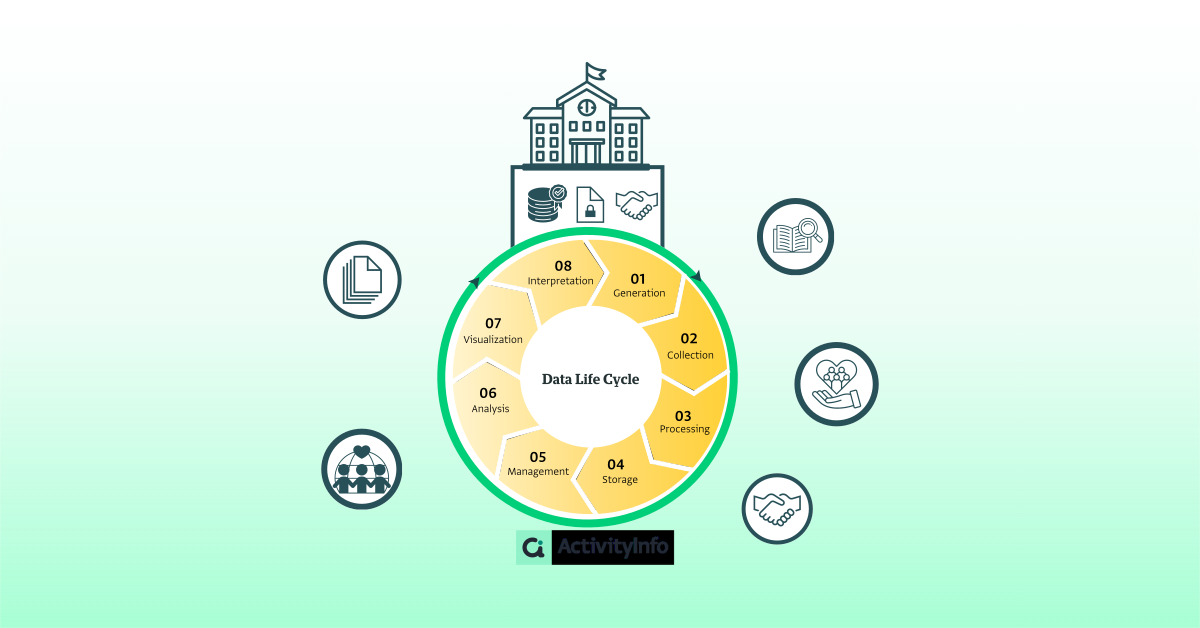
In this article, we identify the types of Non-Formal Education programs available and we look at the key challenges and components of an information management system for Non-Formal Education such as accelerated and remedial education, including Processes, People and Technology.
Types of Non-Formal Education programs
According to the Inter-agency Network for Education in Emergencies there are different types of programs that can tackle education support depending on the type of barrier that prevents students from learning:
- Bridging programs: This is a preparation course applicable when there is a language or curriculum difference between home and host education systems. It is short-term and targeted and supports students entering into a different type of certified education. Language acquisition courses fall under this type.
- Remedial programs: This type of program provides additional short-term content or skill support when students’ competence is behind a certain level. It is concurrent with regular classes.
- Catch up programs: This type is addressed to children and youth whose education has been disrupted due to external factors such as poverty, marginalization, conflict or crisis for less than one year. It is short-term, covers the content missed, and supports their re-entry to the formal system.
- Accelerated education programs (AEP): This type of program is addressed to children and youth whose education has been disrupted due to external factors for over a year. It provides disadvantaged students with a flexible and age appropriate, accelerated education to help them get equivalent certified competences for basic education.
Explore a Decision Tree map by Inee for further guidance.
Challenges in Non-Formal Education information management
There is a wide range of challenges in Non-Formal Education information management, often encountered in other types of interventions.
- Tracking student mobility: Unlike formal schools with fixed academic calendars, NFE programs experience high rates of student mobility, temporary dropouts, and irregular attendance due to migration, displacement, or economic shocks. This makes tracking and monitoring the progress of student cohorts challenging, if there isn’t a structured system in place to monitor changes.
- Duplication of effort, delays in reporting: Multiple implementing partners, NGOs, and UN agencies often collect data in the same geographic region using different indicators or systems, resulting in the duplication of activities or fragmented reporting. In the absence of integrated Management Information Systems, teams rely heavily on manual file transfers, such as emailing separate Excel spreadsheets back and forth. This can create version-control issues, untraceable data modifications, and information loss. As a result, there can be delays in reporting and sharing key data with local Ministries of Education or donors.
- Internet connectivity: Programs frequently operate in remote, low-resource, or emergency settings characterized by shortage of hardware, unreliable power grids, and lack of stable internet connectivity. This makes data collection challenging and can introduce significant delays in reporting, and gaps in program delivery.
- Data security: Last but not least, data security is crucial. When sensitive student files (including for example protection risks or displacement histories) are stored on insecure mobile devices or shared via open networks, it introduces substantial data security vulnerabilities. Due to the vulnerability of populations in emergency contexts (such as refugees or internally displaced persons), strict data protection protocols are mandatory to prevent harm.
Processes: The Data Lifecycle in Non-Formal Education information management
In Non-Formal Education and emergency contexts, establishing standardized operational procedures for each stage of the data lifecycle is critical. Because these programs operate outside formal school registries, information management teams must build structured protocols to ensure data quality from initial intake to final system handover.
Let’s look at some phases of the lifecycle in more detail:
1. Registration and Baseline Assessment
The initial stage establishes the student record and determines programmatic placement. It requires two distinct data collection workflows:
- Demographic and vulnerability mapping: Collecting unique student identifiers, age, gender, displacement status, and household contact information. In emergency settings, this phase also captures specific vulnerability flags (e.g., child protection risks, separated child status) to coordinate with case management teams.
- Pedagogical baseline assessment: Administering simplified, rapid assessment tools or targeted foundational literacy and numeracy diagnostics. Students are usually grouped into instructional levels based on these scores rather than their age or biological grade level.
2. Ongoing monitoring and operational oversight
Once the cohort is established, information systems transition to ongoing monitoring to prevent dropout and maintain operational oversight.
- Attendance and attrition monitoring: Tracking daily or weekly presence. In fluid environments, data protocols must define an exact threshold for "inactivity" (e.g., three consecutive unexcused absences).
- Rapid verification procedures: When a student crosses the inactivity threshold, a verification process is triggered. Field staff or community volunteers conduct household follow-ups to determine the cause, such as seasonal migration, economic shocks, or relocation to a different displacement camp. The database should be updated with specific exit codes (e.g., "Transitioned", “Dropped out due to…”) rather than leaving records blank.
3. Continuous assessment
This phase manages the data that proves learning recovery and tracks individual student progression through the curriculum.
- Formative/Continuous assessment data: Regular data entry completed by facilitators during weekly milestones. This allows M&E/impact teams to monitor if specific classrooms are stagnating or progressing as planned.
- Summative evaluations (midlines and endlines): Formal reassessments using the same standardized tools from the baseline phase. Information systems must map these final scores directly to individual baseline records to compute the absolute learning gain. This data determines if a student is ready for graduation, certification, or formal re-entry.
4. Reporting and handover
The final phase ensures that the data generated by the NFE program is utilized for broader sector coordination and institutional sustainability.
- External coordination reporting: Aggregating data into standardized formats required by humanitarian coordination bodies, such as the global or national Education Clusters, UNHCR, or UNICEF.
- Transition and system integration: When a program ends or a student transitions back to formal schooling, the data must be packaged for handover to the national Ministry of Education or the receiving formal school network. This requires aligning NFE student IDs with the national Education Management Information System (EMIS) frameworks so the formal system recognizes the student's learning achievements and placement level.
People: Key stakeholders and their data needs in Non-Formal Education information management
1. Students, parents, and communities
While they do not enter data, they are the primary source of information and hold explicit rights over it. They have to provide accurate demographic, vulnerability, and educational history data during intake. In emergency contexts, they must be engaged through Accountability to Affected Populations (AAP) mechanisms. This means they must receive clear, accessible communication (in local languages) regarding why their data is collected, how it is protected, and how they can request its correction or deletion.
2. Data collectors: Field facilitators, volunteer teachers, and community mobilizers
These individuals conduct primary data entry via paper registers or offline mobile collection tools like ActivityInfo’s integrated mobile app. They need to record daily/weekly student attendance and track reasons for absence. They administer and record baseline, midline, and endline learning diagnostics and more.
Because they operate in low-resource environments, their IM responsibility must be limited to data entry and immediate verification, not complex data cleaning or analysis.
3. Information management and M&E officers
This role acts as the technical bridge between field operations and headquarters. They design data collection forms, and maintain central databases. They execute Data Quality Assurance (DQA) protocols to identify and correct data entry errors, duplicate records, or anomalies from the field. Lastly, they are the ones aggregating localized data into master datasets and generating analytical dashboards.
In emergency responses, this role is strictly bound by data protection workflows; they are responsible for ensuring proper data access and that Personally Identifiable Information (PII) is restricted.
4. Program managers and education directors
These are the internal decision-makers who utilize the processed data to manage the intervention. They consume IM dashboards to make operational decisions (e.g., reallocating textbooks to classrooms showing rapid learning advancement, or deploying caseworkers to centers with high attrition rates). They authorize data access requests and supervise staff adherence to the organization's data protection policies.
They do not manage raw data but they rely on analyzed, high-level trends provided by the IM/M&E team to steer the program.
5. External coordination bodies and donors
NFE programs in emergencies must report upward to the broader humanitarian ecosystem.
- Education Clusters/UN working groups: Compiling standardized data from various NGOs to track the overall emergency response footprint, prevent duplication of services, and identify geographic gaps in education coverage.
- Institutional donors: Reviewing aggregated, anonymized impact data to verify compliance with grant requirements, monitor value-for-money metrics, and approve subsequent funding tranches.
These actors only receive secondary, highly aggregated, and completely anonymized data packages. They are restricted from accessing raw student-level profiles or sensitive case management files.
Technology: Key software for Non-Formal Education information management
The right information management technology for Non-Formal Education (NFE) in emergency settings can help a program scale safely ensuring data security and timely reporting. The technology choice should match the operational constraints of the emergency environment (e.g., poor network connectivity). Specialized software like ActivityInfo are designed to resolve this type of challenge.
If a data entry system requires a continuous 4G connection or high-end laptops, field facilitators will revert to paper tracking sheet methods, delaying critical monitoring. ActivityInfo addresses this with:
- Offline-first mobile architecture: The platform is built specifically for low-connectivity environments. Field staff can use the integrated ActivityInfo mobile app on their mobile devices or tablets to input daily attendance, student registrations, and learning assessments without an active internet connection. Data is cached securely as a draft on the local device.
- Progressive Web App (PWA) links: Program administrators can generate lightweight web and app collection links. These allow local teams to save forms directly onto their devices. Geolocation coordinates are captured natively via the device’s built-in GPS without requiring network access.
- Automated & manual synchronization: Once a device enters an area with 3G, 4G, or Wi-Fi coverage, the system initiates synchronization to push pending field updates safely to the centralized platform.
In the absence of a unified Management Information System, NFE programs can fall back on manual file transfers, emailing standalone Excel spreadsheets or sending photos of paper registers via WhatsApp. As discussed, this dynamic creates significant version-control issues, accidental data overwrites, data loss, and an inability to compare regional student learning progress.
ActivityInfo offers:
- No-code relational database builder: The software allows M&E teams to construct a centralized, structured database utilizing forms and sub-forms without writing code. Student profiles, attendance logs, and diagnostic test tracking are kept in a single cloud location rather than scattered across desktop folders.
- Eliminating 5W spreadsheet burdens: Instead of consolidating tasks at the end of each reporting cycle, regional updates are compiled dynamically. The platform features native data validation tools that block incorrect inputs before the record is submitted.
- Real-time synthesis and APIs: Aggregated data feeds directly into built-in analysis features, such as pivot tables and maps. Additionally, APIs allow seamless integration with external tools like Power BI or Tableau, ensuring that program directors can access immediate, verified KPIs without waiting for manual script compilations.
Last but not least, NFE databases in humanitarian settings contain sensitive information, including student names, protection statuses, psychological evaluations, and household displacement histories. Traditional spreadsheets and basic survey applications often lack fine-grained security protocols. If a field device is lost or compromised, personal identifiable information (PII) is exposed, creating direct risks for vulnerable populations.
ActivityInfo offers:
- Granular role-based access control (RBAC): Administrators define strict permissions for every user. Field facilitators can be restricted to view or modify data only for their assigned education center. Concurrently, external donors or national clusters are restricted to seeing aggregated, anonymized metrics, completely shielding individual child records.
- Single sign on (SSO) authentication: ActivityIngo integrates external Identity Providers (e.g. Microsoft Entra ID, Google Workspace) and offers a Single-Sign On experience to users. Organizations can extend two-factor authentication policies to ActivityInfo and users can sign in with their work account to ActivityInfo.
- Comprehensive audit log: Every addition, modification, or deletion of a record is captured in an unalterable audit log. This accountability ensures that data integrity is protected and unauthorized data modifications can be traced and remedied instantly.
Conclusion
Establishing an Information Management framework is a fundamental requirement for the success of Non-Formal Education (NFE) programs in emergency settings. When crisis situations disrupt traditional education infrastructure, accelerated learning, bridging, and remedial programs must rely on agile data systems to accurately track student progress and operational footprint.
By aligning People, Processes, and Technology implementing organizations can move away from fragmented, insecure data practices like manual spreadsheet sharing and disjointed field reporting. Ensuring clear operational workflows for field staff, implementing a standardized data lifecycle, and leveraging offline-first, secure platforms like ActivityInfo allows programs to protect data integrity even in the most low-resource environments.
Do you wish to learn more about ActivityInfo and how it can support your Non-Formal Education or remediation programs? You can always contact us for a demo customized to your organization’s needs.