Strategic Impact Measurement - Designing and Tracking Advanced Indicators
As M&E systems mature, practitioners often realize that technically “correct” indicators are not always useful indicators. Counts increase, targets are met, reports are delivered yet decision-makers still struggle to understand why results vary, whether change is sustainable or how to adapt interventions in real time.
Strategic indicators that are sensitive to change and advanced indicator design respond to this gap. The focus here is on indicators that are theory-informed, sensitive to change, and analytically meaningful, enabling learning and adaptation, moving a step further from simple compliance.
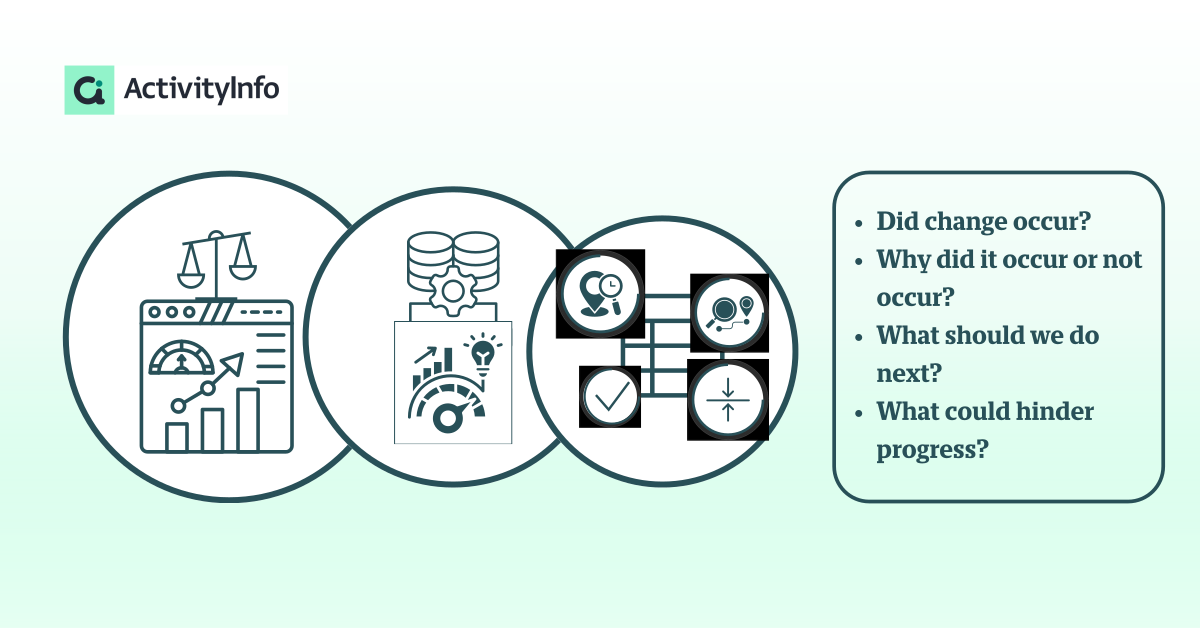
The purpose of the indicators in this case is to answer questions such as:
- Did change occur? (accountability)
- Why did it occur or not occur? (learning)
- What should we do next? (support decision making)
- What could hinder progress? (risk monitoring)
Designing such indicators is only half of the challenge. The other half is operationalizing them in a way that remains manageable, transparent, and auditable. This is where platforms like ActivityInfo can play a key role not as a mere data repository, but as a structured environment that supports advanced measurement logic.
In this article, we examine some key points related to advanced indicator design and we look at how ActivityInfo can support practitioners tracking such indicators.
We also have many more resources on indicator design depending on your level of familiarity with indicators:
- Webinar: Indicators - From project-level to strategic reporting in humanitarian and development settings
- Webinar: From Theory of Change to database design for evidence based decision making - Indicators
- Designing disaggregated indicators for equity and avoiding double counting
- Top ten common mistakes in indicator tracking and how to avoid them
- Step-by-step guide to creating an Indicator Tracking Table (ITT)
Leading and lagging indicators
Leading indicators give early signals on whether change is likely to happen (forward-looking) and allow proactive management (e.g. number of households adopting sanitation best practices). These should be proximate, sensitive and actionable.
Lagging indicators confirm whether outcomes/impact have actually occurred (backward-looking) (e.g. reduction in diarrhoeal disease incidence months later). These should be credible, stable and comparable over time.
If you find misalignments between the two categories, there might be flawed assumptions in the theory of change.
Composite indicators for multidimensional phenomena
Composite indicators combine multiple individual indicators into a single measure to capture multidimensional constructs. They are used when no single indicator fully represents the concept of interest (e.g., “community resilience”). Building them involves standardization, weighting, aggregation, and sensitivity analysis and the purpose is to support the interpretation of the results.
Advanced design involves:
- Clear conceptual grounding: what dimensions truly matter?
- Transparent selection of component indicators.
- Explicit weighting logic (equal, theory-based, or empirically derived).
- Sensitivity analysis to understand how design choices affect results.
Sensitivity and change responsiveness
An advanced indicator must be capable of detecting meaningful change, even when the change is incremental, not just variation. Otherwise it could create false stability or irrelevant noise.
Design choices that affect sensitivity include:
- Scale granularity (binary vs. ordinal vs. continuous measures).
- Measurement frequency.
- Threshold definitions for meaningful change, keeping noise out.
- Susceptibility to external shocks or seasonal variation.
A best practice is to test indicator behavior over time and revise those that consistently fail to respond to program influence.
Proxy and indirect indicators
Proxy indicators are used when strong theoretical or empirical linkages exist between the proxy and the outcome. They are sometimes unavoidable but their choice should be justified theoretically and validated empirically where possible.
Example: using school attendance as a proxy for “children’s engagement with education”.
Good proxy design requires:
- A clear causal rationale linking the proxy to the underlying outcome.
- Evidence (or at least plausibility) that the proxy moves with the construct of interest.
- Periodic reassessment of whether the proxy still holds as context evolves.
Proxies should always be documented as such, with explicit limitations, to avoid false certainty in interpretation.
Structural and system indicators
These are indicators that reflect system dynamics (e.g., policy changes, governance improvements) rather than just project inputs/outputs.They are relevant for complex interventions or systems-level change initiatives where progress is rarely linear.
The design of such indicators understand that they:
- Move slowly or non-linearly.
- Require mixed methods for validation.
- Serve learning purposes more than target enforcement.
- Shed light on how systems evolve.
Qualitative indicators
The purpose here is to combine quantitative indicators with qualitative measures to add depth, meaning, and context. The goal is not to “quantify everything,” but to make qualitative insight systematic, comparable, and auditable. For example, narrative data can validate statistical trends or suggest mechanisms of change.
- Use ordinal scales with clearly defined criteria.
- Pair numeric ratings with narrative justification.
- Code qualitative findings into analytic categories over time.
Triangulation and indicator validation
In triangulation, we use multiple data sources and methods to cross-validate indicator results and improve confidence in findings. It sometimes helps in identifying contradictions or underlying complexities.
We can always ask:
- Do multiple indicators point in the same direction?
- Are trends consistent across sources and methods?
- Where do discrepancies appear, and what do they reveal?
Indicator portfolios and balanced measurement frameworks
To reduce blind spots, you can use a set of measures instead of single indicators. A balanced approach including for example leading, lagging, input, quality, and equity indicators can benefit more advanced programs.
Indicators for adaptive management
Indicator systems should be structured in a way that supports real-time decision making and adaptations. If an indicator doesn’t inform action, you might need to reconsider it.
Predefined thresholds, indicator reviews, feedback loops and linking indicator change to management responses are some ways to ensure that indicators connect measurement to action and reinforce adaptive management.
Impact measurement in action: ActivityInfo for tracking advanced indicators
The early indicator design phase will play a determining role when the time to set up the impact measurement system arrives. You will be able to make the most out of ActivityInfo and organize and align everything in your system once that groundwork is done.
In ActivityInfo you can design and link forms to each other ensuring that data is always pointing at the same project or outcome structure. Hierarchical database structures (via reference fields or subforms) allow indicators to be grouped by outcome, theme, or theory-of-change component. With validation rules you can prevent incorrect values that can obscure the reality and start with a solid basis. Data integrity is thus ensured both at point of entry and as the program evolves.
Even if you use proxy indicators you can always ensure they are consistently linked to the outcomes they represent and with description fields you can collect metadata that document the justifications, assumptions and limitations of each proxy. Similarly you can use structured categorical fields, and combine numeric values with narrative fields to provide explanations making system-level change tracking simpler.
Then, if you collect different types of indicators in multiple data collection forms, you can always combine these using formulas and calculated measures within the system. This ensures that the logic is preserved over time in one single system instead of getting lost in spreadsheets.
Dashboards and notebooks allow practitioners to visualize trends and make comparisons, making monitoring long term outcomes much easier. Instead of getting only endline snapshots, you can always observe incremental changes. And regular data review routines can be built around dashboards that are informed in real-time based on the latest data rather than static reports. In addition, you can add narrative in these types of reports so as to keep the interpretation of the data close to the source rather than in separate reports.
Lastly, thanks to role-based permissions, audit logs and the possibility to create a centralized storage of indicator definitions and formulas you can ensure that there is clear ownership, version control and documentation for your work, making data governance the backbone of your indicator tracking system.
Making the change to strategic measurement that helps us understand why change happens and when to intervene might be challenging especially when indicator tracking is based on a fragile or siloed system based on disconnected spreadsheets. In ActivityInfo, you can create a structured advanced indicator tracking platform that can always be transparent, reproducible and usable at scale.
Do you wish to learn how ActivityInfo can support your advanced indicator tracking system?
Never hesitate to contact us for a demo customized to your organization’s needs.