How MHPSS and M&E Teams Can Co-Design Information Management Systems
According to the World Health Organization, 1 in 5 people in humanitarian emergencies are experiencing a mental disorder. In these contexts, mental health and psychosocial support (MHPSS) programmes play a vital role in helping people cope with traumatic experiences and rebuild their emotional and psychological well-being.
However, in the complexity of humanitarian crises, it is not always clear whether these efforts are truly achieving their objectives. This is where monitoring and evaluation (M&E) becomes important, helping organisations understand whether their interventions are making a difference and where support needs to be strengthened.
In this article, we explore how MHPSS and M&E teams can work together to co-design effective information management systems that support impact measurement and better decision-making, while ensuring that each team has access only to the data relevant to their roles.
What is MHPSS? Meaning, definition, and its cross-sectoral nature
As defined in the IASC guidelines, the composite term mental health and psychosocial support (MHPSS) refers to any type of local or outside support that aims to protect or promote psychosocial well-being and/or prevent or treat mental disorders. A key characteristic of MHPSS interventions is that they are multi-sectoral. They are frequently embedded within health, protection, education, nutrition, WASH, livelihoods, and other sectors.
How monitoring and evaluation supports MHPSS programmes
Monitoring and evaluation (M&E) plays a central role in understanding whether MHPSS programmes are achieving their intended goals and ensuring accountability. It is also essential for ensuring that programmes do no harm, as poorly designed or implemented interventions can unintentionally have negative effects. Monitoring focuses on what is happening during implementation, using observations, field visits, and data collection to help teams track whether activities are progressing as expected. In parallel, evaluation looks at changes over time, whether at the start, in the middle, or at the end of a programme, to understand whether it is making a meaningful difference.
Rather than being treated as a separate component, M&E should be built into MHPSS programmes from the start. According to IASC guidelines each MHPSS programme is unique and requires an M&E framework tailored to its specific design and context. However, using a common set of outcome indicators, along with both quantitative and qualitative measurement tools, helps build a stronger evidence base and demonstrate the effectiveness of MHPSS interventions.
Overall, a solid M&E structure helps MHPSS teams define clear project objectives, identify what needs to be measured, and decide how data will be collected and used to inform decisions.
To explore M&E frameworks in MHPSS programmes and the related ethical considerations in more detail, watch our webinar Bridging MEAL and Case Management in Information Systems for MHPSS.
MHPSS and M&E teams: Different roles, different priorities
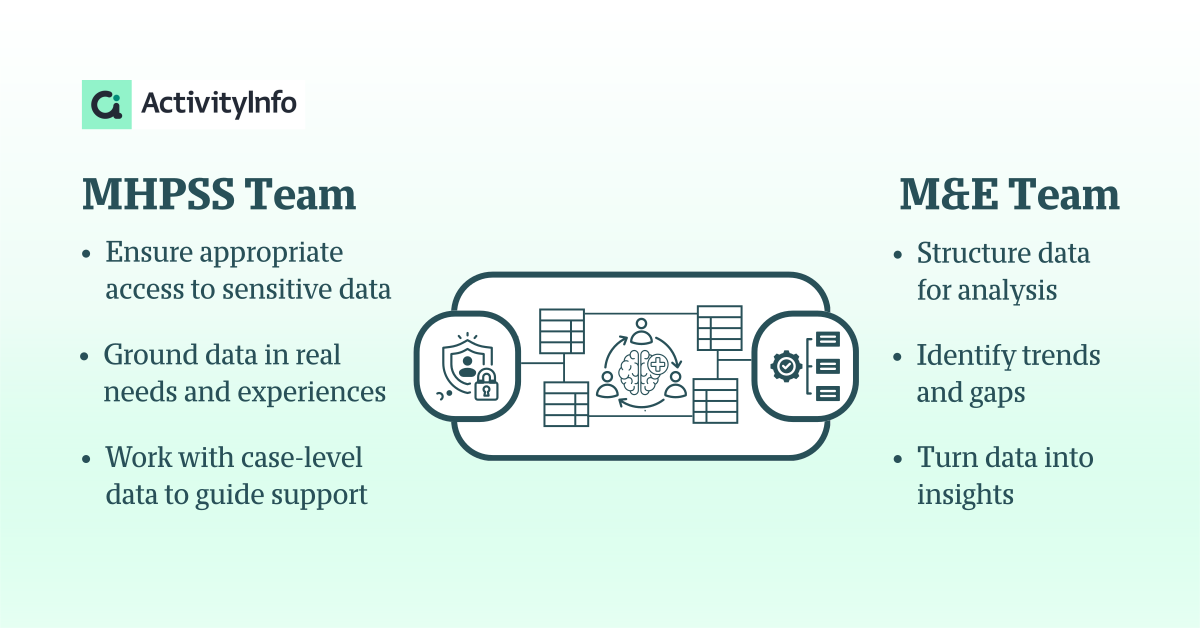
Despite following the same organizational mission, MHPSS practitioners and M&E teams work toward different objectives, shaped by their distinct roles. MHPSS practitioners, including psychologists, social workers, counsellors, and caseworkers, are focused on providing care. Their work centres on direct human interaction, building trust, and responding to sensitive needs, addressing both immediate distress and longer-term recovery and resilience, outcomes that are not always easy to quantify.
Moreover, since mental health touches every aspect of daily life, MHPSS practitioners operate across multiple layers. From training frontline staff to integrating mental health into sectors such as health, education, and protection. Much of this work is context-specific, shaped by real-time interactions rather than predefined structures, making it difficult to capture in standardised formats.
M&E teams, on the other hand, focus on structuring data so that programmes can be measured and reported. They develop results frameworks, define indicators, and establish data collection plans that determine what data is collected, how, when, and by whom. Their work is centred on data, ensuring its quality, consistency, and usability across projects and partners. This includes validating data, analysing trends over time, and producing reports that inform decision-making and support accountability to donors.
At the same time, the two roles rely on different types of data. MHPSS practitioners work with detailed, case-level information such as assessments of distress, coping capacity, referrals, and session notes that guide ongoing support. This information is highly sensitive and should only be accessible to those directly involved in care.
M&E teams, in contrast, work with aggregated and anonymised data, such as changes in well-being scores, service uptake, or trends over time, allowing them to assess programme performance without accessing personal information. Clear boundaries between these types of data are essential to protect individuals, while still enabling teams to collaborate and use information effectively.
The missing link: Why information management systems can fall short in MHPSS
These different priorities can make collaboration in data management challenging. Data collected by MHPSS teams may not fit easily into reporting frameworks, while M&E requirements can sometimes feel disconnected from day-to-day service delivery. As a result, information remains fragmented and valuable insights are under-used. As explored in our article on understanding different stakeholders’ data needs in case management systems, each role within an MHPSS system relies on different types of data to do their work effectively.
| Role | Caseworkers and field staff | Supervisors and case managers | M&E/MEAL teams | |
|---|---|---|---|---|
Data needs |
-Case intake and client profiles -Service history and assessments -Alerts and follow-up tasks -Confidential notes and attachments |
-Caseload dashboards and summaries -Case status by worker or location -Compliance with SOPs or timeframes -Escalation or incident tracking |
-Disaggregated case data (e.g. by age, gender, location) -Trends over time (referrals, outcomes, service types) -Built-in dashboards or export-ready data for analysis, access to APIs |
This becomes even more challenging given the inherently multi-sectoral nature of MHPSS programmes. Services across health, protection, and education often use different tools and reporting formats, making data difficult to consolidate and use consistently. Without linking these data points, it is difficult to track changes in well-being or understand outcomes.
How MHPSS and M&E teams can collaborate to co-design effective systems
MHPSS and M&E teams can overcome these challenges by working together from the beginning. The following elements can make this collaboration more effective.
1. Define shared concepts
Align on key definitions and concepts to ensure consistency from the start. For example, both teams should define in the same way what constitutes an “outcome” or how changes in well-being, or coping capacity are measured. Without shared concepts, teams risk collecting and interpreting data differently.
2. Map data flows and define essential data
Clarify how data moves across MHPSS services, from case identification and follow-up to reporting. Agree on what data is essential at each stage to avoid duplication and unnecessary data collection, and who should have access to it.
3. Align indicators
Use established frameworks, such as IASC guidelines, to define indicators that reflect key outcomes like functioning, well-being, distress, and coping capacity. These indicators should reflect how services are actually delivered, so they can be used in practice as well as for reporting. When teams align on them, it creates a shared understanding of what is being measured and how progress is tracked.
4. Share expertise across teams
Effective systems rely on close collaboration between teams. M&E and MHPSS professionals bring different but complementary expertise, from structuring and analysing data to ensuring it reflects real service delivery and context. Bringing these perspectives together helps ensure that data is both usable for reporting and meaningful for improving services.
5. Clarify roles and access to information
It’s important to be clear about who is responsible for collecting, managing, and using different types of information across the programme. When roles are clearly defined, information can be both protected and useful, without exposing sensitive details.
6. Schedule feedback sessions for continuous improvement
Create space for regular reflection on how data is collected, used, and interpreted. This can include periodic reviews or check-ins where M&E teams share trends across programmes and MHPSS practitioners provide context from the ground. When this exchange happens consistently, it helps teams adjust indicators, improve data collection, and refine how services are delivered.
From fragmented data to integrated systems in MHPSS
When MHPSS and M&E teams work in alignment, the result is a more coherent and effective information management system. Instead of fragmented data across different tools and teams, information comes together in a centralized, relational system that follows every case’s journey over time, linking assessments, services, referrals, and outcomes. It brings MHPSS practice and M&E requirements into the same structure. For example, an individual’s assessment and follow-up sessions can be linked to changes in functioning or well-being scores, making it possible to track progress over time and report consistently.
Tools such as ActivityInfo are designed to support this kind of approach, helping teams manage information across programmes in one place. By combining qualitative insights with quantitative data, the system supports day-to-day service delivery while enabling consistent measurement of outcomes. More importantly, it shifts the role of data from reporting alone to informing decisions. This allows teams to identify gaps, adjust services, and strengthen the overall effectiveness of MHPSS responses.
Would you like to explore how ActivityInfo could support your MHPSS case management system? Feel free to contact us for a demo customized to your needs.