Case Management and Predictive Advocacy - Building a High-Impact Advocacy System through Anonymized Case Trends
In many social impact organizations, case management and advocacy often operate in isolation. Case management focuses on the immediate, practical needs of an individual. Advocacy focuses on changing the high-level laws or systems that affect everyone.
When these two areas are separated, valuable information is lost and field level evidence cannot support advocacy campaigns effectively. However, by using a case management system that also tracks anonymized trends, organizations can move from reacting to problems to predicting and stopping them before they grow.
In this article, we explore what it means to have such a case management system in place and how software such as ActivityInfo can bridge the gap between individual service and systemic change, ensuring that every data point serves both the client’s immediate needs and the broader goal of advocacy.
The power of predictive advocacy
When information flows correctly from the frontline to the advocacy office, the organization gains the ability to ‘predict’ a crisis.
For example, if the case management system shows a small but steady increase in a specific problem such as a new type of legal document being rejected in one specific city, the advocacy team can act immediately. They don't have to wait for a disaster to happen. They can use that early data to contact authorities and push for a policy change before thousands of more people are affected. This makes the advocacy system proactive rather than reactive.
Creating such a system provides value at every level of the organization. Clients receive better individual care, but they also benefit from systemic changes that address the root cause of their problems. Case managers feel more empowered. They see that the data they enter into the case management software is not just "paperwork," but a tool that helps change the world. And the organization builds a reputation for expertise as it can back up its claims with solid, anonymized data trends, and becomes a more credible partner for governments and international donors.
Building a unified system for all stakeholders
To build a system that benefits everyone, we must understand the specific requirements and expectations of at least the three key teams involved:
- Case managers: Acting as their frontline, their primary goal is service delivery. They need case management software that is secure, user-friendly, and helps them track a client's progress. Their expectation is that the data they enter will help them manage their workload and provide better care.
- Monitoring & Evaluation: Being the bridge, the M&E team looks at the "big picture." They require standardized data that can be measured over time. Their role is to look for patterns across hundreds of case files (records) without ever looking at individual names. They turn raw data into evidence.
- Advocacy teams: Advocacy professionals have the role of the ‘voice’ and need verified proof to influence donors or governments. They expect the system to provide "real-time" facts. Instead of saying, "We feel there is a problem," they can say, "Our data proves there is a 20% increase in this issue."
Bridging the gap while maintaining confidentiality
The biggest challenge in connecting case work to advocacy is protecting the identity of the people we serve. We must maintain strict data confidentiality principles to ensure we "do no harm."
- Anonymization at the source: Before any data is shared with the advocacy team "Personally Identifiable Information" (PII) must be removed or redacted. This includes for example names, exact birth dates, and ID numbers.
- Access Control: The advocacy team should never have direct access to the raw case management data. They should only receive "aggregated reports" that show numbers and locations rather than individual stories.
- Informed Consent: It is essential to be transparent with clients. When asking for consent for their use of their data, the purpose of the data collection should be explained. Here we can explain that while their personal details are private, the general information about their challenges will be used to help change the law for others. This maintains trust and follows ethical standards.
How ActivityInfo supports advocacy via your case management system
ActivityInfo offers specific functionalities that allow Case Management, M&E, and Advocacy teams to collaborate safely and efficiently.
Secure and flexible data collection with:
- Mobile and offline access: Staff can record case notes on tablets or phones in remote areas without internet. The system synchronizes once they are back online, ensuring no data is lost.
- Relational databases: You can link a single "Client Profile" to multiple "Intervention records" (like medical visits or legal sessions) or advocacy related themes. This provides a complete history of care without duplicating data entry.
Role-based access control:
- Permission, conditions, parameters, and grants to specific resources: You can set up the system so that case managers see full personal details, but the advocacy team only sees reports with aggregated data or only specific fields.
Real-time analysis, notebooks and dashboards:
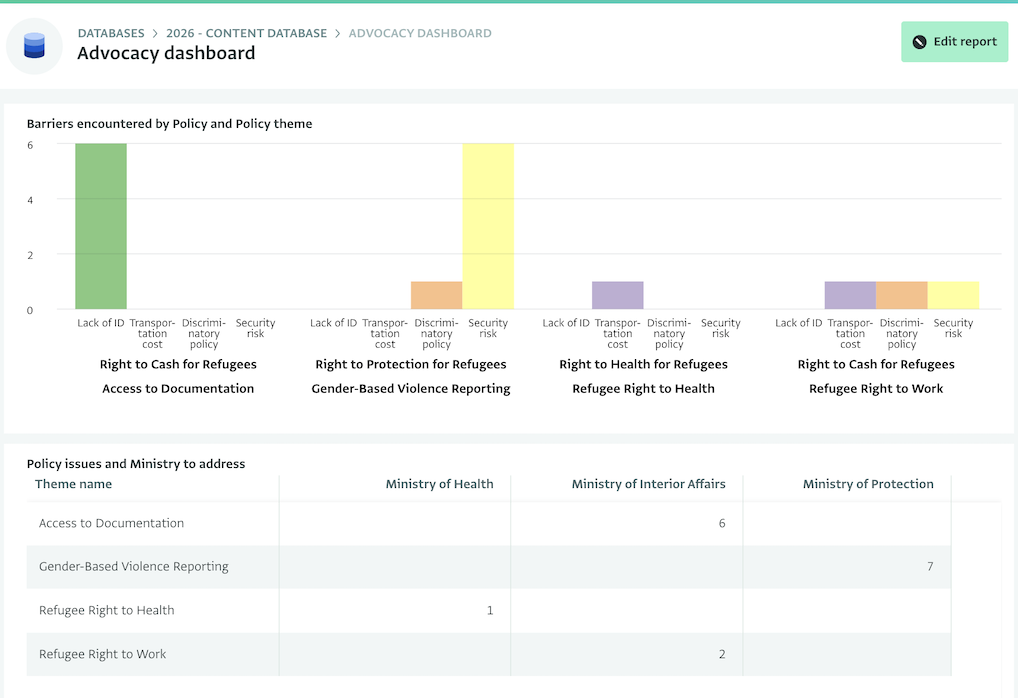
- Pivot tables and charts: ActivityInfo turns raw case data into visual trends automatically. If there is a sudden spike in a specific type of case, the system highlights it immediately.
- Integrated reporting: Advocacy teams can access live dashboards that show the "big picture" evidence they need for meetings with donors or government officials, without ever needing to ask the case managers for a manual report.
Audit logs and accountability
- History tracking: ActivityInfo maintains a permanent audit log and a record detail overview. You can see who edited or deleted a record and what changes were made. This ensures that the system remains a "trusted source" and meets data protection standards.
By using a unified information management platform like ActivityInfo, organizations can ensure that every piece of information collected on the frontline serves a dual purpose: providing immediate, high-quality care to an individual and building the evidence to support advocacy and improve the system. Interested in learning how ActivityInfo could support your organization?
Contact us to discuss more.