Data management for nonprofits - From Short-term Data Collection to Long-term Impact Measurement
Measuring long-term impact is a challenge that many nonprofits face especially when most of the data they collect are related to short-term outcomes gathered during program implementation.
So getting to the numbers that actually show improved well-being, sustained behavior change, stronger communities, or systemic shifts becomes a real challenge for impact measurement. The constraints are usually related to funding cycles, staff capacity, participant mobility, ethical limits on long-term follow-up, and reporting requirements that prioritize near-term results.
To address this challenge a shift to a more realistic approach can help. This article explains how organizations can address this challenge by shifting to a more realistic approach where the short-term data collected is used to build evidence over time, and explains how ActivityInfo can help you manage data and this process effectively.
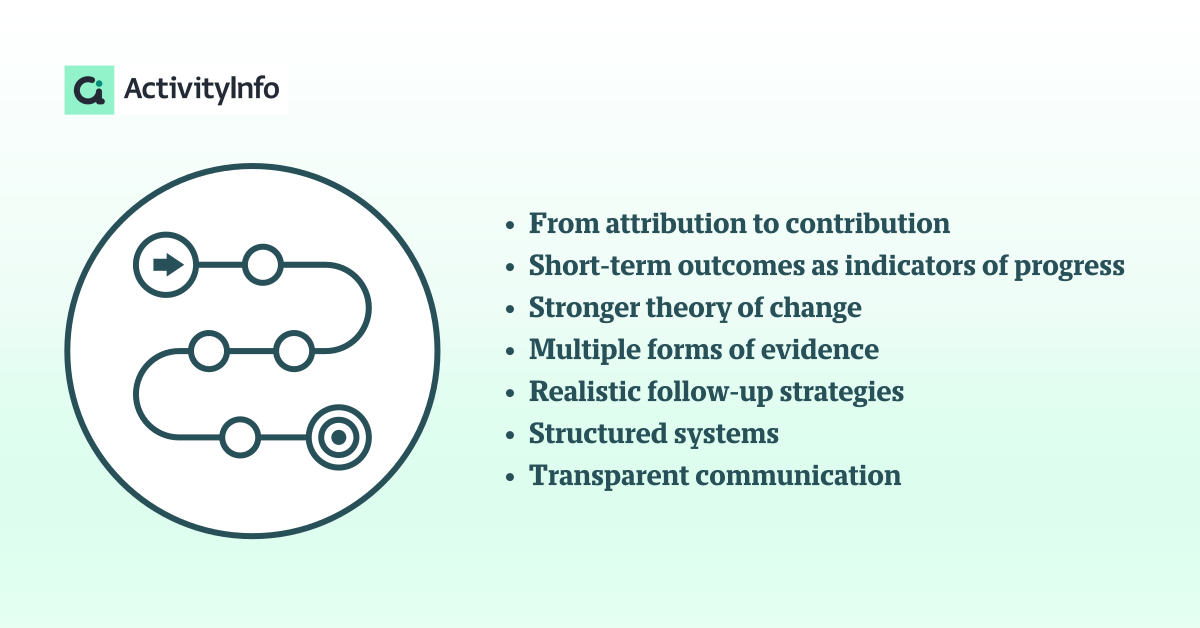
We'll look at how you can:
- move from attribution to contribution
- strengthen your theory of change
- using short-term data as meaningful indicators of progress
- combine qualitative and quantitative evidence
- organize your information in a structured system
- design realistic follow up strategies
- communicate transparently with stakeholders
What is long-term impact and why is it hard to measure?
In nonprofit practice, impact is often used to describe durable change that persists beyond the program itself. Examples might include sustained income stability, improved life outcomes, or long-term community resilience. It is also useful to consider concerns by practitioners and evaluators that impact can be a vague or overloaded term. It is sometimes used interchangeably with outcomes, results, or even outputs, which can create confusion and unrealistic expectations.
Then, impact measurement becomes a difficult task when a program or a project focuses on short-term data collection, for example because of:
- limited project timeframes
- funding cycles that emphasize near-term deliverables
- operational constraints that make long-term follow-up difficult
Rather than treating “impact” as a single observable moment, it’s more useful to think of it as a sequence of linked results over time grounded in evidence and logic. To build a credible evidence base over time the first step is to articulate a strong logic model and acknowledge that you are going to use short-term results to support longer-term hypotheses.
Following are some steps you can take to get started.
Move from attribution to contribution
Because short-term data rarely allow definitive causal attribution to long-term changes, a helpful shift is from “Did our program cause this impact?” to “How does this evidence build toward longer-term change?”
Well-articulated theories of change are a key tool here. These frameworks lay out the assumed causal pathways from activities to outputs, outcomes, and long-term impact and help guide both what you measure and how you interpret the results. Evaluators widely recommend using a theory of change as a foundation for impact evaluation, since it allows reasoning about causal links even when data spans multiple timeframes.
This reframing:
- acknowledges complexity and external influences,
- reduces pressure to overclaim,
- and aligns better with the data most nonprofits can realistically collect
Use short-term outcomes as indicators of progress
Well-chosen intermediate short-term outcomes (changes observed immediately after program activities) can serve as indicators or proximate signals of longer-term effects. For instance:
- improved knowledge or skills as precursors to behavior change
- early adoption of practices that are known to persist over time
- short-term stability that enables longer-term gains
The important thing is to be explicit about the assumptions that link short-term results to longer-term goals. This helps you build an evidence narrative that is internally consistent and plausible, even if it isn’t causal in a strict experimental sense.
Strengthen the theory of change
When long-term measurement is not feasible, the theory of change becomes even more important.
A strong theory of change:
- makes causal assumptions explicit,
- draws on existing research or sector evidence where possible,
- clarifies what needs to happen after the program ends for long-term impact to occur.
Short-term data is then interpreted within this logic, rather than in isolation. This does not eliminate uncertainty, but it makes the reasoning behind conclusions more transparent and credible.
Combine multiple forms of evidence
Building evidence over time rarely relies on a single dataset. Nonprofits often strengthen their understanding of long-term impact by triangulating data, combining:
- routine quantitative program data
- qualitative interviews or case studies
- follow-up surveys with small samples
- external or administrative or partner data where available
For example, qualitative methods like the Most Significant Change (MSC) technique are often used to capture nuanced, participant-reported indicators of meaningful change that don’t show up in short-term quantitative data. Even limited or periodic follow-up conducted with a subset of participants can add valuable depth and context to short-term indicators.
Design realistic follow-up strategies
Longitudinal studies are not the only option. Repeated short-term observations, collected well, can accumulate into meaningful evidence. More feasible approaches may include:
- sampling a subset instead of tracking all participants for a period follow-up
- conducting follow-ups at key milestones rather than continuously
- partnering with other organizations or agencies that already collect relevant data
- revisiting the same indicators across multiple program cycles or cohorts to detect patterns over time
These approaches let nonprofits accumulate evidence that strengthens confidence in causal assumptions.
Organize evidence with structured systems
To build evidence over time, you need consistent data management especially when data comes from multiple sources, partners, or timeframes.
This is where tools like ActivityInfo can play a useful role as it can help your nonprofit centralize, standardize, and analyze project data from activity tracking to outcomes and indicator reporting all within the same platform.
For example, nonprofits can:
- store short-term outcome data consistently across years
- link indicators to programs and theories of change
- combine quantitative data with contextual information
- track aggregated indicators over time to observe trends across reporting cycles
- connect short-term results to longer patterns that are relevant for impact narratives with structured databases
Used this way, systems support learning and accumulation of evidence rather than one-off reporting.
Communicate transparently with stakeholders
Lastly, when presenting evidence to funders or decision-makers, it’s important to remember that the point is not to ‘prove success’ but to ‘demonstrate the truth’:
- be explicit about what the data shows and what it does not
- distinguish short-term results from longer-term aspirations
- share the logic and assumptions that connect short-term outcomes to impact
- frame your findings as part of a growing evidence base, not definitive proof
- report unintended negative impacts and the Do No Harm principle: Be honest about any negative ripples or unexpected shifts the program may have caused.
This kind of transparency builds credibility and trust with donors, and aligns expectations.
Measuring long-term impact with short-term data is less about finding the perfect indicator and more about adopting a realistic mindset.
By focusing on contribution, strengthening theories of change, combining multiple forms of evidence, and tracking results consistently over time, nonprofits can move away from the pressure to prove impact and toward the more sustainable goal of building evidence over time.
For over 15 years, ActivityInfo has been supporting INGOs, NGOs and other types of nonprofits all over the world measure the impact of their projects, programs and organizations as a whole.
Wondering how ActivityInfo can help you maintain a structured approach to short-term data collection that can be leveraged to support impact measurement? Contact us to discuss further.